If you run an eCommerce or manufacturing business, you have likely worked with a third party logistics company at some point, whether you realized it or not. These companies store products, pack orders, and move freight for thousands of brands every day. Today, most people know them by the acronym 3PL.
However, not all 3PL Providers are the same. Some offer simple storage and shipping, while others take over a company’s entire logistics department. Choosing the wrong type of partner can lead to higher costs, slower deliveries, and frustrated customers.
In this guide, we explain what third party logistics companies do, break down the four main types, compare their key differences, and share practical tips to help you choose the right partner for your business.
TL;DR
- Third party logistics (3PL) companies manage outsourced warehousing, transportation, inventory, and order fulfillment for other businesses.
- There are four main types: standard 3PLs, service developers, customer adapters, and customer developers.
- Each type offers a different level of service, customization, control, and cost, from basic storage to fully outsourced logistics.
- The right partner depends on your order volume, product complexity, growth plans, and budget.
What Are 3PL Providers?
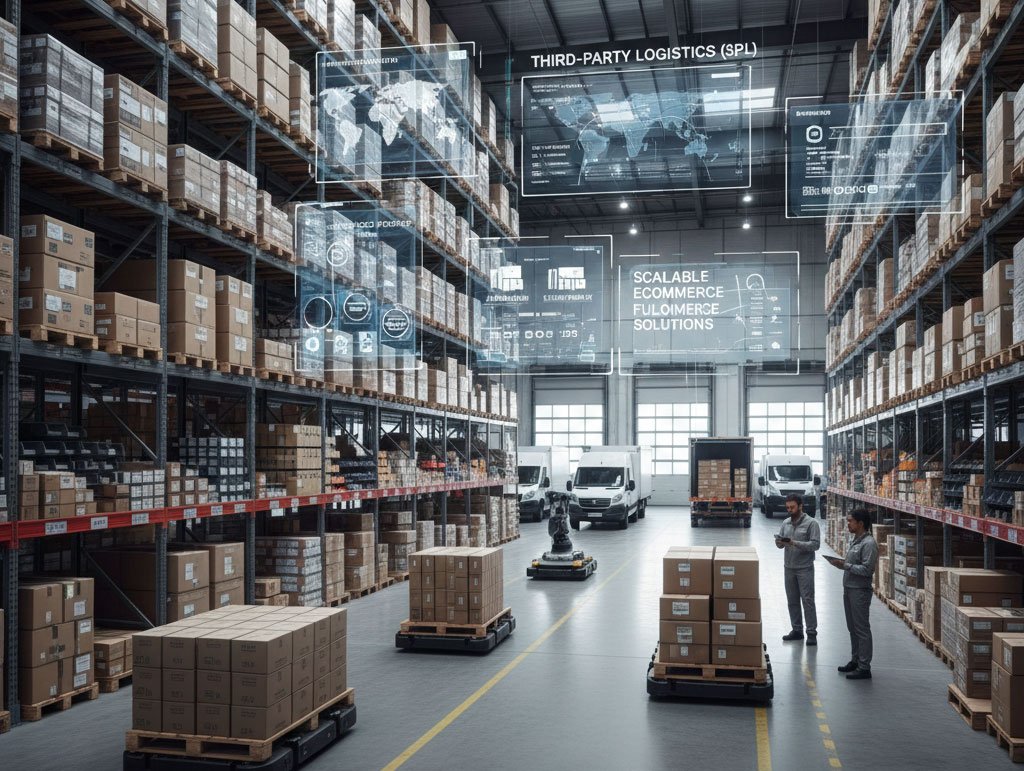
Third party logistics companies, or 3PLs, provide outsourced logistics services for other businesses. These services typically include transportation, warehousing, inventory management, and order fulfillment. Instead of building and running these operations in-house, a business hands them to a specialist partner.
At QRC Logistics, we define third party logistics as a service partner responsible for managing the outbound logistics activity of an eCommerce retailer or manufacturer. In practice, this means receiving inventory, storing it safely, picking and packing orders, and delivering products to customers or retail locations.
Businesses usually partner with a 3PL to:
- Reduce costs: Avoid the expense of leasing warehouse space, buying equipment, and hiring a full logistics team.
- Scale faster: Add storage capacity and shipping volume during busy seasons without long-term commitments.
- Access better shipping rates: Benefit from the carrier relationships and freight volume that logistics companies have already built.
- Focus on core business: Spend more time on product development, sales, and marketing instead of day-to-day operations.
If you are still deciding whether outsourcing makes sense, it helps to compare in-house warehousing vs. working with a 3PL before you choose a partner.
Types of 3PL Providers
Like most sectors connected to eCommerce, the logistics industry has grown significantly in recent years. As a result, third party logistics companies now offer a much wider range of solutions than simple storage and trucking. Most fall into one of four main categories, each designed for a different level of business need.
Standard 3PL
A standard 3PL offers the core basics: warehousing, transportation, pick and pack, and inventory management. These companies focus on doing a small number of things efficiently and at an affordable cost.
Many newer logistics companies fall into this category. A standard 3PL is often the right starting point for small and growing eCommerce brands that need dependable storage and shipping without complex extras. Working with a reliable Canada 3PL partner at this stage gives you a strong foundation to grow from.
Best for: Startups and small to mid-sized businesses with straightforward logistics needs.
Service Developer 3PL
Service developer 3PLs build on the standard offering with value-added services. These may include IT solutions, compliance management, security, and real-time shipment tracking. Together, these services improve reliability, safety, and visibility across the supply chain, which often leads to cost savings.
Some service developers also offer advanced picking and cross-docking. Cross-docking moves goods directly from inbound to outbound transportation without long-term warehouse storage. This reduces storage costs and helps products reach customers faster.
Best for: Businesses that need more visibility, faster turnaround, or specialized handling but still want to manage their overall logistics strategy.
Customer Adapter 3PL
Customer adapter 3PLs are ideal for businesses with complex operations that need customized logistics solutions. These companies take control of most or all logistics activities and often design tailored processes around the client’s existing systems and goals.
Their services may include full shipping management, transportation management systems for tracking, returns processing, and customer service support. Many of these partners also offer end-to-end ecommerce order fulfillment services, from receiving inventory to processing returns. Advanced technology is often what sets these companies apart.
These services typically cost more, but they deliver comprehensive support for businesses with demanding requirements.
Best for: Established brands with high order volumes, multiple sales channels, or complex product requirements.
Customer Developer 3PL
Customer developer 3PLs take over a client’s logistics operations entirely and effectively become the company’s logistics department. This option suits businesses that want to outsource every logistics function and remove the need for an in-house team.
These are often the largest third party logistics companies, with the experience and resources to manage complex, large-scale operations. While there are fewer of them, they offer end-to-end solutions at the highest service level and the deepest level of integration.
Best for: Large enterprises that want a fully outsourced, long-term logistics partnership.
Key Differences Between the Types of 3PLs
While every 3PL handles some combination of storage and shipping, the four types differ in several important ways:
- Scope of services: Standard 3PLs cover the basics, while customer developers manage every part of the logistics process.
- Level of customization: Service developers add optional extras, while customer adapters and developers design processes around your specific business.
- Cost: Pricing generally increases as services become more advanced and more customized.
- Control: With a standard 3PL, you keep most strategic decisions. With a customer developer, the partner leads your logistics operations.
- Technology: More advanced partners usually offer stronger tracking, reporting, and system integrations.
Understanding these differences helps you compare 3PL Providers on more than price alone. A low quote from the wrong type of partner can end up costing more in delays, errors, and missed opportunities.
What Are the Features of Different 3PL Logistics Services?
Regardless of type, most third party logistics companies offer some combination of the following services:
- Warehousing: Storage, packaging, labelling, and order fulfillment, often with specialized solutions based on product type and shipping requirements.
- Transportation: Road, air, sea, and rail freight, using established carrier networks to deliver the most efficient shipping options.
- Forwarding: Managing the movement of goods from origin to destination, including customs clearance, documentation, tracking, and storage.
- Shipping management: Overseeing the full logistics process, with added services such as carrier negotiations and route optimization.
- Finance: Accounting, auditing, credit facilities, and payment processing related to logistics operations.
- Information: Digital and web-based tools that improve visibility and communication across the supply chain.
How to Choose the Right 3PL Partner
Start by reviewing your current operations. Consider your monthly order volume, the number of products you sell, any special handling needs, and where your customers are located. These factors will quickly show whether you need basic support or a fully customized solution.
Next, think about where your business is heading. A partner that fits today may not keep up if you plan to expand into new regions, add retail channels, or double your order volume. Look for a company that can scale with you.
Finally, compare more than pricing. Ask about technology, inventory accuracy, delivery performance, and customer service. Our guide to the best 3PL companies in Canada and how to choose one walks through the key questions to ask before signing a contract.
Conclusion
3PL Providers simplify the complex and often costly logistics process for eCommerce retailers and manufacturers. Whether you need basic warehousing or a fully outsourced logistics department, there is a solution designed for your business size and complexity.
Each type of 3PL offers different services, capabilities, and pricing. By understanding these differences and matching them to your goals, you can choose a partner that lowers costs, improves delivery speed, and supports long-term growth.
Get Started with QRC Logistics
Choosing the right third party logistics partner has a direct impact on your efficiency, costs, and customer experience. As an experienced Canadian third party logistics company, QRC Logistics works with eCommerce retailers and manufacturers to design solutions that align with their operational goals and growth plans.
With decades of experience, scalable 3PL services, and a focus on reliability and transparency, QRC Logistics helps businesses streamline fulfillment, improve inventory management, and optimize transportation. Contact QRC Logistics today to learn how our third party logistics solutions can support your business.
FAQs
What does 3PL stand for?
3PL stands for third party logistics. It refers to companies that provide outsourced warehousing, transportation, inventory management, and fulfillment services for other businesses.
What are the four main types of 3PLs?
The four main types are standard 3PLs, service developers, customer adapters, and customer developers. Each offers a different level of service and customization.
Which type of 3PL is best for a small business?
Most small businesses start with a standard 3PL because it offers essential warehousing and shipping services at an affordable cost.
Is using a 3PL cheaper than in-house logistics?
In many cases, yes. A 3PL removes the need to lease warehouse space, buy equipment, and hire staff, and it often provides access to discounted shipping rates.