
You have five heavy cartons of inventory sitting on the floor and a delivery date to hit. The receiver wants them on a skid. Your courier account will take them, but the quote per box keeps climbing, and nobody has told you whether the receiving door can even handle a courier drop.
You are trying to answer one question before you book anything: does this shipment go parcel, or does it go freight?
That answer usually comes down to how the goods will be handled at both ends, not how much they weigh.
TL;DR
Send it parcel when the goods fit into one or a few boxes a person can lift and carry, and the receiver accepts courier deliveries at a regular door.
Send it LTL freight when the goods sit on a skid, need a forklift or a pallet jack, or go to a commercial receiver with docks, receiving hours and appointment rules.
The dividing line is handling, not weight. As soon as a forklift, a dock, a tailgate or a booked appointment enters the picture, you are in freight territory.
Price both ways when several heavy cartons share one destination. Consolidating them onto a skid is often cheaper than paying per box, and it gives the receiver one unit to check in instead of five.
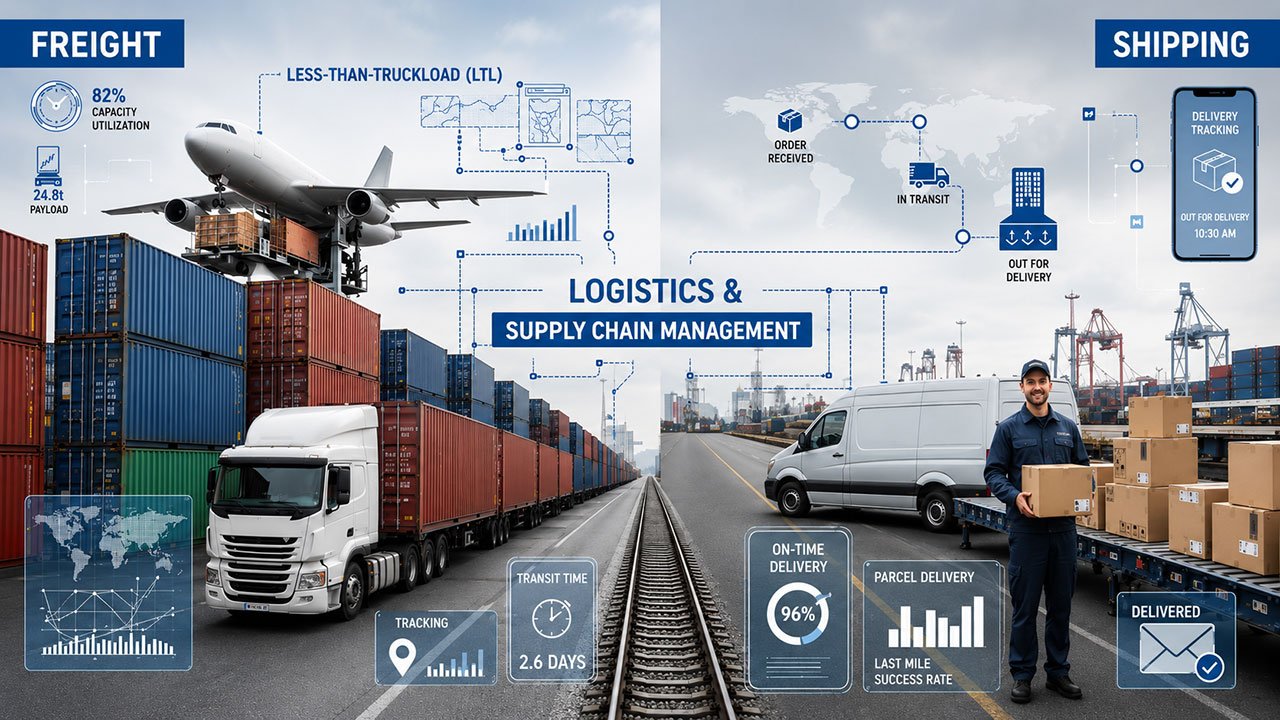
Freight vs. Parcel Shipping at a Glance
| Factor | Parcel Shipping | LTL Freight Shipping |
| Typical shipment | Individual boxes and packages | Pallets, skids, crates or grouped cartons |
| Common use | Ecommerce orders, samples and small parts | Inventory, retail replenishment and commercial goods |
| Packaging | Boxes, mailers and protective packaging | Secured pallets, skids or crates |
| Handling | Individual package handling and automated sorting | Forklifts, pallet jacks, loading docks and tailgates |
| Pricing | Package weight, dimensions, destination and speed | Total weight, dimensions, skid count, lane and service requirements |
| Delivery | Standard residential or business delivery | Dock, appointment, tailgate or scheduled commercial delivery |
| Documentation | Package label and tracking number | Bill of lading, shipment tracking and proof of delivery |
What Parcel Shipping Actually Does
Parcel shipping moves single boxes through a courier or postal network. Each box gets its own label and its own tracking number, then travels through sorting facilities and local delivery routes.
You see it every day. Ecommerce orders, replacement parts, product samples and small shipments going straight to a home or an office.
It works well when the goods fit securely into one or a few boxes and nobody needs equipment to move them. Once a box is too heavy for one person to carry off a truck, parcel starts to strain.
What Freight Shipping Actually Does
Freight shipping moves commercial goods that need more space, more coordination or equipment at each end. The goods may be strapped to skids, packed in crates, or grouped into one larger multi-piece shipment.
Freight comes in three sizes. Less-than-truckload for part of a trailer, partial truckload for a bigger share, and full truckload when you need the whole thing. Which one you pick depends on size, weight, destination, delivery conditions and how much trailer space the load actually takes up.
Less-than-truckload, or LTL, is the middle option most businesses use. Your freight takes up part of a trailer, other shipments fill the rest, and each load still moves under its own transportation plan.
LTL suits palletized inventory, retail replenishment, manufacturing materials, appliances and commercial equipment. All of it is too big or too awkward for parcel handling to make sense.
QRC Logistics provides Ontario LTL and final-mile delivery services for businesses moving palletized freight through regional distribution networks.
How the Two Are Handled on the Ground
Parcel shipments travel as separate boxes. Each one gets loaded, unloaded, scanned and sorted on its own, several times over, before it reaches the door.
LTL freight travels as one handling unit. The skid stays wrapped and banded, and forklifts, pallet jacks and docks move it between terminals, trailers and receiving bays.
That difference matters most at the delivery end. If the site has no dock, you need tailgate service so the load can come down off the truck. Commercial receivers may also set receiving hours, require a booked appointment, restrict site access or ask for signed proof of delivery.
Here is a small change that saves a lot of grief. Consolidate loose cartons onto one skid. The receiver checks in one unit instead of eight, and fewer pieces move through the network unattached.
How Pricing Differs
Parcel rates are built per package. Weight, dimensions, destination and delivery speed set the base, and surcharges get added for oversized boxes, residential addresses and special handling.
LTL pricing looks at the whole shipment instead. Total weight, dimensions, number of skids, origin, destination and the service the delivery needs.
Then the delivery conditions get priced in. Appointments, tailgate service, limited-access sites and extra handling all move the final number.
So compare the totals, not the per-piece rate. When several heavy cartons are going to the same commercial address, add up what the courier would charge for all of them and put that beside a palletized LTL quote. The freight number is often lower, and the shipment arrives as one unit.
How to Prepare an LTL Freight Shipment
Confirm the shipment details first. Write down the pickup and delivery addresses, the number of skids, the dimensions, the total weight, the commodity and the pickup date you want.
Add the receiver’s operating hours, the delivery window and whether an appointment is required. Those details decide the equipment, the routing and the rate, so guessing at them costs you later.
Secure the freight properly. Stack cartons evenly and keep everything inside the pallet footprint. Wrap it, band it, protect the corners and cushion anything fragile so nothing shifts in transit.
Keep the labels visible. The finished load should be stable enough for a forklift or a pallet jack to move without anything leaning.
Check access at both ends. Find out whether pickup and delivery have loading docks or their own material-handling equipment.
If either end has no forklift and no dock, you need tailgate service. Limited-access sites and inside-delivery requests should be flagged before pickup, not discovered by the driver.
Prepare the paperwork. Freight moves with a bill of lading listing the shipper, receiver, commodity, piece count, weight and service instructions.
Complete paperwork keeps the shipment moving. Incomplete paperwork is one of the most common reasons a load sits.
When You Need Both
Most growing businesses end up using parcel and freight side by side. Couriers handle individual customer orders. LTL moves replenishment inventory into warehouses, retailers and other commercial sites.
As volume climbs, the work shifts from booking shipments to managing them. Carrier coordination, route selection, load planning, documentation, tracking, billing and delivery performance all start competing for someone’s attention.
A structured freight management process pulls those pieces together so you keep control of the network instead of chasing it.
LTL Freight Shipping in Mississauga
QRC Logistics runs palletized and skid-based commercial freight through its Mississauga terminal.
That includes per-skid LTL, local cartage, tailgate delivery, scheduled retail drops and proof of delivery across Mississauga and the West GTA.
You can use the Mississauga terminal for local moves and connect the same shipments into QRC Logistics’ wider Ontario network.
Has Your Shipment Outgrown Parcel Delivery?
Tell us the size, the origin, the destination and what the receiving door looks like. QRC Logistics will build an LTL plan around it so your freight arrives as one unit, on the day you promised it.