
Do you have freight to move by truck but are not sure which trailer type to use? For most shippers, the answer is a dry van. These enclosed trailers are the most popular choice on the road because they are versatile, affordable, and easy to book.
Whether you are moving retail stock, building materials, or eCommerce inventory, Dry Van Truck Shipping offers a reliable way to get goods where they need to go. In this guide, we explain what a dry van is, cover common trailer sizes and load capacities, outline the key benefits, and compare dry vans with flatbeds and reefers.
QRC Logistics helps businesses across Canada plan and move dry van freight every day. Our experienced team works with you at every step to make sure your shipment arrives safely and on time.
TL;DR
- A dry van is an enclosed, non-refrigerated trailer used to haul palletized, boxed, and loose freight that does not need temperature control.
- The most common size is the 53-foot trailer, which typically holds up to 26 standard pallets and roughly 42,000 to 45,000 pounds of cargo.
- Dry vans protect freight from weather and theft, suit a wide range of goods, and are usually the most affordable trailer option.
- Choose a reefer for temperature-sensitive goods and a flatbed for oversized items that cannot be loaded through rear doors.
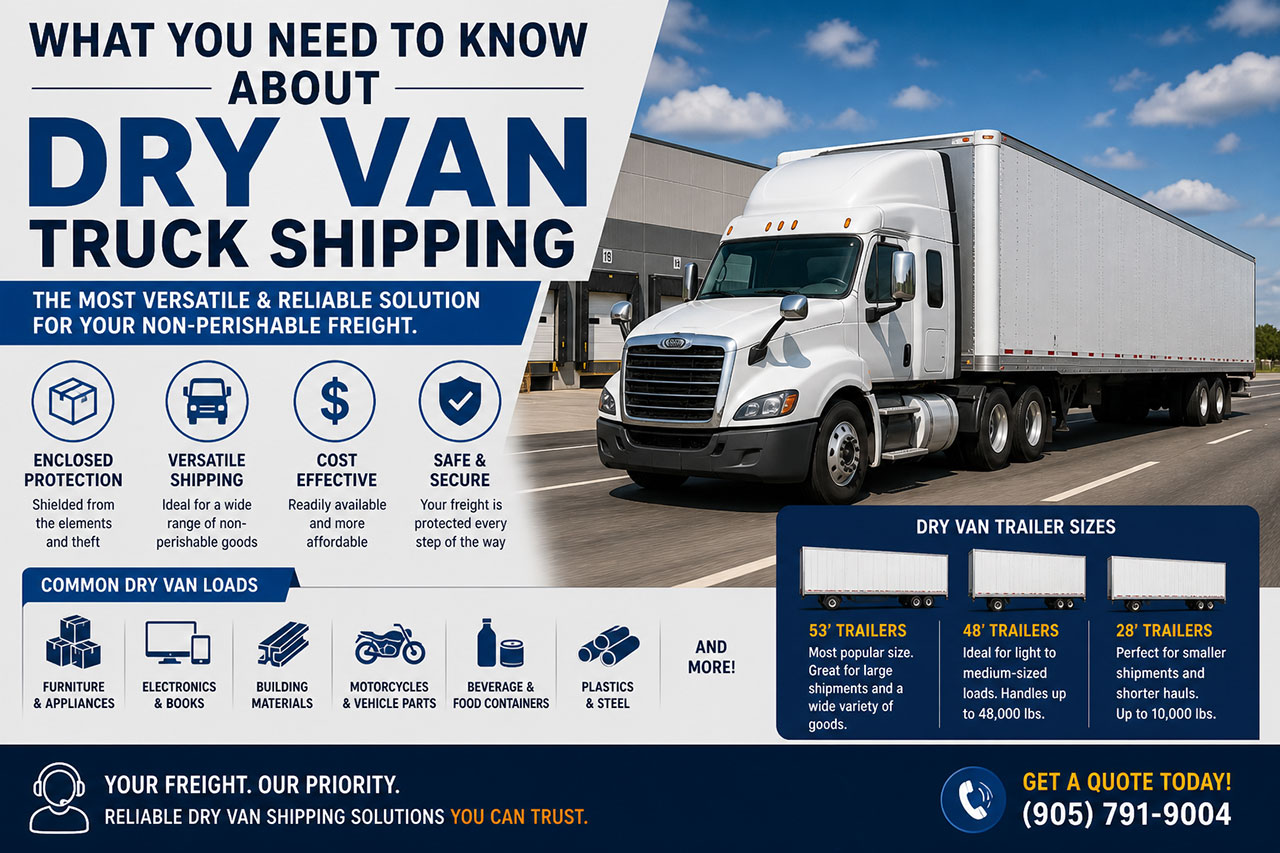
What Is Dry Van Truck Shipping?
Dry van shipping is the movement of freight in an enclosed, non-temperature-controlled trailer pulled by a semi-truck. Dry vans, also known as box trailers, have solid walls, a roof, and rear swing or roll-up doors that keep cargo secure throughout the trip.
The word “dry” simply means the trailer has no refrigeration or heating unit. Because of this, dry vans are used for non-perishable goods such as furniture, appliances, electronics, packaged food, paper products, and general retail merchandise. They are the most commonly used trailer type in North American road freight.
Dry vans can carry full truckload (FTL) shipments, where one customer uses the entire trailer, or less-than-truckload (LTL) shipments, where several customers share the space. If you are new to moving larger loads, our guide on the difference between freight and shipping explains how freight works compared with parcel delivery.
Dry Van Trailer Dimensions
Inside dimensions vary by manufacturer and wall thickness, so it is always best to confirm exact measurements with your carrier. Knowing the approximate size of each trailer helps you estimate pallet count and plan your load. Here is a quick overview of the most common options:
- 53-foot trailer: About 52’6″ long, 8’2″ wide, and 9′ high inside, with room for up to 26 standard pallets.
- 48-foot trailer: About 47’6″ long inside, with room for up to 24 standard pallets.
- 28-foot pup trailer: About 27’6″ long inside, with room for up to 14 standard pallets, and often pulled in pairs.
- Straight box truck: Typically 16 to 26 feet long, with larger models carrying up to 12 standard pallets.
53-Foot Trailers
The 53-foot trailer is the most popular dry van size in Canada and the United States. It offers the most usable space of any standard trailer, which makes it ideal for full truckloads of furniture, appliances, household goods, consumer products, and building materials. Most shippers default to a 53-foot trailer for long-haul and high-volume freight.
48-Foot Trailers
Before 53-foot trailers became the standard, 48-foot trailers were the most common size. They are still widely used today, especially for regional routes and medium-sized loads. Their slightly shorter length makes them easier to maneuver at tight docks and in busy urban areas, while still offering plenty of space for palletized freight.
28-Foot Pup Trailers
Pup trailers are shorter dry vans designed for smaller shipments. They are popular with LTL carriers because two pups can be pulled together as “doubles,” which allows carriers to separate freight by destination and improve efficiency. Pup trailers are a good fit for lighter loads, city deliveries, and terminal-to-terminal moves.
Box Trucks
Box trucks, also called straight trucks, have the cargo box and cab mounted on the same frame. They are smaller than tractor-trailers and are best suited for local and short-distance deliveries. Many box trucks have liftgates, which makes them ideal for delivering pallets to businesses and retail locations without loading docks. For smaller pallet moves in your area, local cartage and per-skid LTL services are often more cost-effective than booking a full trailer.
How Much Cargo Can a Dry Van Trailer Hold?
The amount of cargo a dry van can carry depends on the trailer size, the weight of the truck and trailer themselves, and local weight regulations. A standard 53-foot dry van typically carries approximately 42,000 to 45,000 pounds of cargo, although limits vary by province, state, and equipment.
Many shipments run out of space before they reach the weight limit. Lightweight but bulky items, such as furniture or packaged consumer goods, often fill the trailer floor first. Heavy, dense freight such as paper or beverages may hit the weight limit while space remains. Either way, freight should be evenly distributed across the trailer to keep axle weights legal and the load stable.
Common Dry Van Loads
Dry vans can carry almost any non-perishable product that fits through the rear doors. Some of the most common loads include:
- Packaged food and beverages that do not need refrigeration
- Consumer electronics and appliances
- Furniture and home décor
- Building materials, flooring, and fixtures
- Auto parts and accessories
- Paper products and plastics
- Retail store replenishment and eCommerce inventory
As long as the item does not require temperature control and can be loaded through the rear doors, a dry van can usually transport it.
Benefits of Dry Van Truck Shipping
Dry vans are the go-to choice for many shippers because they balance protection, flexibility, and cost better than most other trailer types.
Protection from the Elements and Theft
Because the trailer is fully enclosed, cargo stays shielded from wind, rain, snow, and road debris. This is especially valuable during Canadian winters. Dry vans can also be locked and sealed, which helps protect high-value shipments from theft and tampering during transit.
Versatility
Dry vans can carry a wide variety of freight, from loose cartons to fully loaded pallets. You can ship furniture one week and electronics the next using the same type of equipment. This flexibility makes dry vans suitable for almost any industry that moves non-perishable goods.
Cost-Effectiveness
Dry van freight is usually more affordable than specialized options because the trailers do not need refrigeration units, tarps, or extra securement equipment. They are also widely available from many carriers, which keeps rates competitive. To lower your transportation spend even further, explore these practical ways to limit freight costs.
Easy Loading and Availability
Most dry vans are designed for standard loading docks, so warehouses can load and unload them quickly with forklifts or pallet jacks. Because they are the most common trailer type, carriers can often book dry vans on short notice, even during busy seasons.
Dry Van vs. Other Trailer Types
Dry vans are not the right fit for every shipment. Here is how they compare with two other popular trailer types.
Dry Van vs. Flatbed
Flatbed trailers are open decks with no walls or roof. They are loaded from the sides or top using forklifts or cranes, which makes them ideal for oversized machinery, lumber, steel beams, and other items that cannot fit through rear doors. However, flatbed freight is exposed to the weather and must be tarped and secured, which adds time and cost. Dry vans offer far more protection for standard palletized freight.
Dry Van vs. Reefer
Reefer trailers have built-in refrigeration units that keep cargo at a set temperature. They are designed for perishable goods such as fresh produce, dairy, frozen food, and some pharmaceuticals. Because of the extra equipment and fuel, reefer shipping costs more. If your products do not need temperature control, a dry van is the more economical choice.
When Should You Choose a Dry Van?
Dry Van Truck Shipping is usually the best option when your freight is non-perishable, fits through standard rear doors, and needs protection from weather and theft. It works well for both full truckloads and shared LTL shipments, and it is ideal for regular retail replenishment, warehouse transfers, and long-distance moves.
If you ship to multiple regions, working with a carrier that offers reliable Canada-wide freight coverage makes it easier to keep transit times consistent and simplify your logistics.
QRC Logistics Offers Dry Van Truck Shipping
As a trusted Canadian freight and logistics company, QRC Logistics is proud to offer dependable dry van services for businesses of all sizes. Our experienced team will help you find the best and most cost-effective solution for your freight, whether you need a full truckload, an LTL shipment, or local pallet delivery.
With access to a wide range of trailers and trucks, we can accommodate almost any type of non-perishable shipment. Get in touch with us today at (905) 791-9004 to find out how we can help move your freight safely and on time.
FAQs
What is a dry van trailer?
A dry van is an enclosed, non-refrigerated trailer used to transport freight that does not need temperature control, such as furniture, electronics, and packaged goods.
How many pallets fit in a 53-foot dry van?
A 53-foot dry van typically fits up to 26 standard 48″ x 40″ pallets loaded on the floor, or more if the freight can be safely double-stacked.
What is the difference between a dry van and a reefer?
A reefer has a refrigeration unit that keeps cargo at a controlled temperature, while a dry van does not. Dry vans are generally more affordable for non-perishable goods.
Can a dry van carry LTL freight?
Yes. Dry vans are commonly used for less-than-truckload shipments, where several customers share trailer space and pay only for the room their freight uses.