
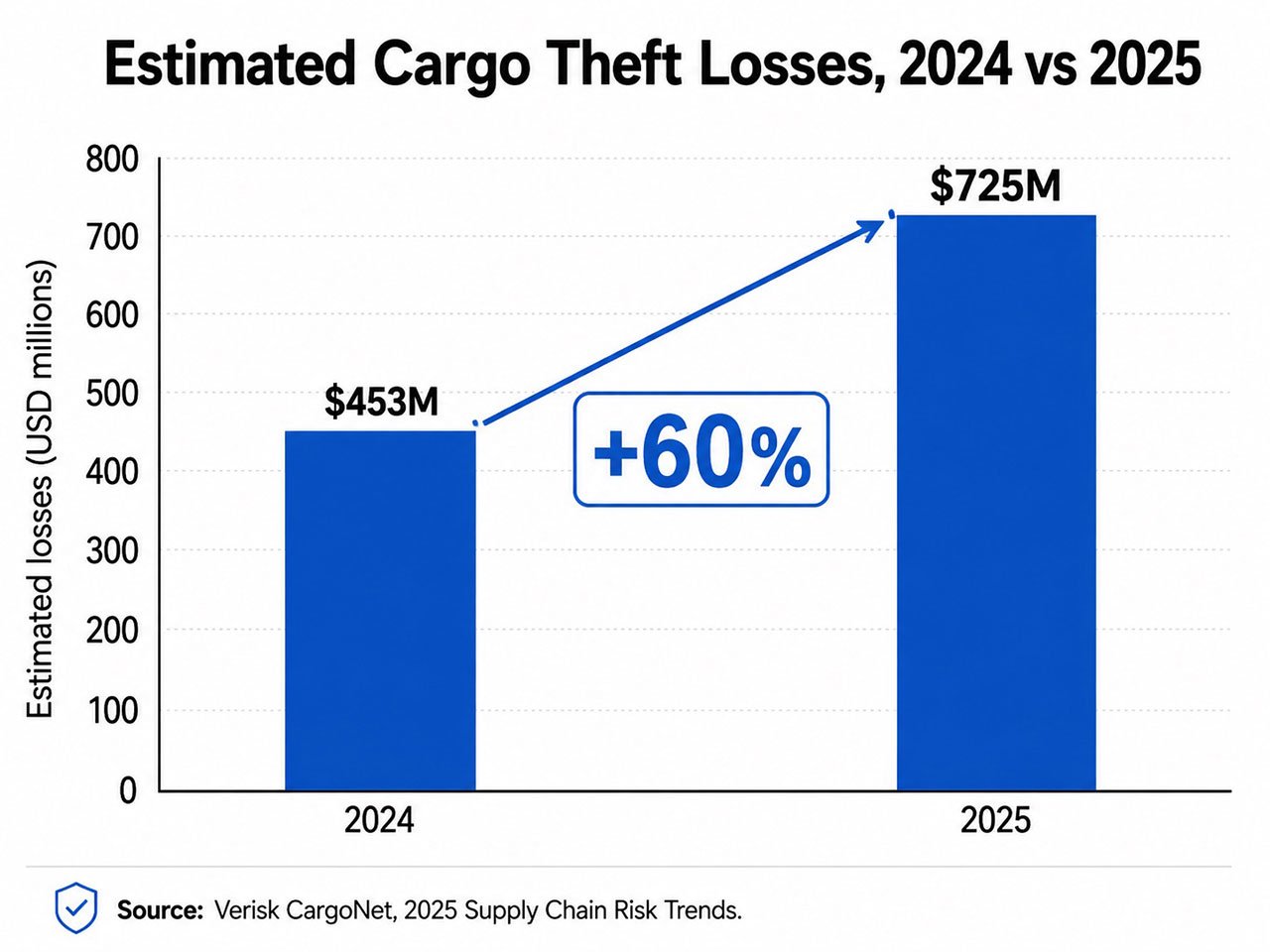
Cargo theft losses across the United States and Canada rose 60 percent in 2025. The total: an estimated 725 million dollars. That number comes from the FBI’s Internet Crime Complaint Center, in an April 30, 2026 public service announcement about cyber threat actors compromising broker and carrier accounts to post fake listings on load boards.
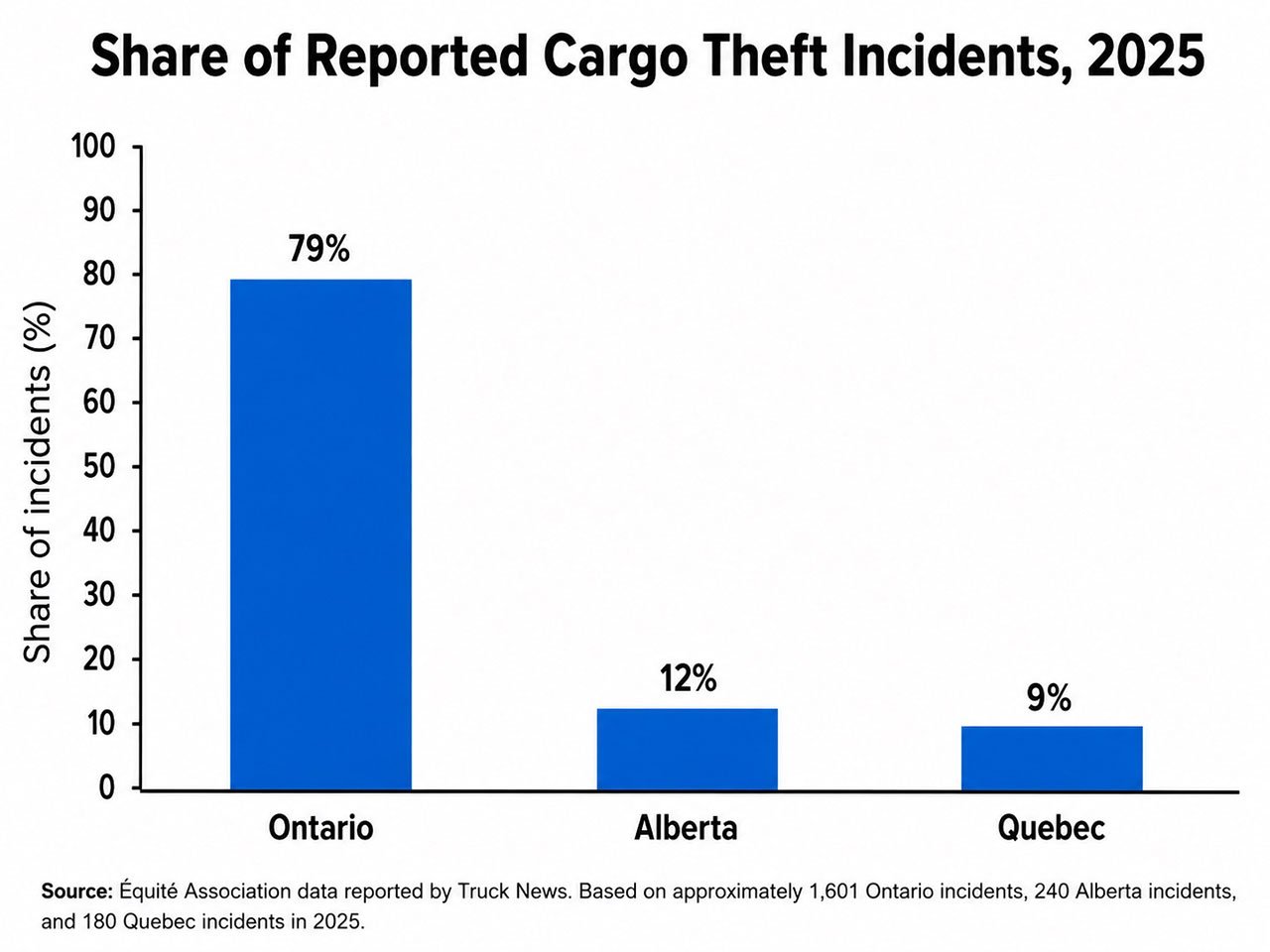
Ontario had its own bad year. The province logged more than 1,600 cargo theft incidents in 2025. The Greater Toronto Area ranked as the country’s top hotspot, according to Canadian-specific data DAT Freight and Analytics published in June 2026.
TL;DR
- Cargo theft losses across the US and Canada rose 60 percent in 2025, reaching an estimated 725 million dollars, per the FBI’s Internet Crime Complaint Center.
- Ontario logged more than 1,600 cargo theft incidents in 2025, with the Greater Toronto Area ranked the country’s top hotspot, according to DAT Freight and Analytics.
- Équité Association has documented criminals assuming legitimate carrier identities or fabricating carrier profiles to secure loads through brokers or direct shipper calls.
- Most of these schemes depend on an intermediary somewhere in the process, a load board posting, a broker relationship, or an unauthorized re-brokered handoff, to give fraud a place to insert itself.
If you tender freight in this province, that is not background noise. It is a direct answer to a question every shipper needs answered. Who has custody of my shipment between pickup and delivery? Who do I call if something goes wrong?
Freight Fraud Is Rising Across Ontario
This is not a hypothetical risk. It is a documented trend, worth understanding before you book your next load.
The FBI’s warning describes the method. Cyber threat actors break into broker and carrier email accounts through spoofed domains and fake URLs, then post fake listings on load boards. The shipper ends up handing freight to thieves instead of the carrier they thought they hired.
Équité Association, which runs Canada’s National Cargo Theft and Recovery program, documented a related pattern in February 2026. The tactic: identity theft. Criminals either assume a legitimate carrier’s identity or invent a profile from scratch, then use it to book a load through an online broker or a direct call to the shipper.
None of this makes brokers the problem. Most schemes rely on an intermediary somewhere in the process, a place for fraud to insert itself. When the same company that quotes the load also drives it, there are fewer places for that to happen.
Brokerage vs Unauthorized Re-Brokering
A broker handing your load off to a properly vetted, authorized carrier is normal, and it is often the right call. There is a section below on exactly when that is true.
Unauthorized re-brokering is different. It happens when a carrier takes a load with no plan to haul it themselves, then hands it off to a second carrier the shipper never approved or even knew existed.
DAT Freight and Analytics draws this exact line: the original broker loses control of the carrier relationship, the liability chain, and the ability to track the shipment once that second handoff happens.
The practical effect is simple. You no longer know who is driving your freight, because the chain got longer than you agreed to when you booked the load.
Carrier vs Broker vs 3PL
These terms get used loosely in the industry. It helps to define them by what actually happens, not by how each company markets itself.
A direct, asset-based carrier owns the trucks. The driver is either an employee or an owner-operator running under that carrier’s own authority. You have one point of contact from pickup to delivery, and that same company typically carries liability for the freight the entire way, under its own insurance.
A freight broker does not touch the freight. A broker arranges for a carrier to move your load and earns a fee for that arrangement. This is a legitimate, licensed function, and a large share of freight in Canada moves this way.
A 3PL manages a broader logistics relationship. That can include warehousing, fulfillment, and distribution. It may use its own trucks, brokered capacity, or a mix of both, depending on the lane.
QRC Logistics operates as an asset-based direct carrier for its Ontario and Montreal lanes. This post is written from that seat, so it is worth naming upfront. More on exactly how that works further down.
Who Controls Your Freight
Walk through custody step by step. This is where the difference between models shows up, in a way that matters when something goes wrong.
With a direct carrier, you typically have one phone number, one dispatch team, and a single insurance policy covering the move. If the ETA slips, or the proof of delivery does not match what you expected, you are talking to the company holding the freight. Not a go-between.
With a brokered or re-brokered load, your contact may not be the company physically holding your freight. That gap matters most right when you need it least: damage in transit, a missed appointment, a claim that has to move fast.
Two or three companies get involved instead of one. So ask upfront. Who files the claim first? Who pays first? How long does resolution usually take?
This is also where an unauthorized re-broker does the most damage. The company you booked with may not even know, in real time, who is currently holding your freight.
A dispatcher fielding your status call cannot give you an accurate ETA for a truck they do not control. That is not a communication failure. It is a longer chain than you agreed to, and that is just how it works.
The Three Models Compared
| Direct Asset-Based Carrier | Traditional Broker to Vetted Carrier | 3PL Network Model | |
| Who owns the truck | The carrier itself | A third-party carrier the broker selects | Varies by lane, owned or brokered |
| Who you call for status | One dispatch team, same company the whole move | The broker, who then confirms with the carrier | The 3PL, who then confirms with whichever party is running that lane |
| Who is liable for the claim | The carrier, under one policy | Depends on the carrier’s coverage and the broker’s contract terms | Depends on which party physically held the freight |
| Where fraud risk concentrates | Generally lower, concentrated at a single point of custody | At the carrier selection and verification step | At each handoff between network partners |
| When this model makes sense | Regional, high-frequency lanes where one carrier can run the whole route | Cross-border, multi-province, or specialized equipment needs | Multi-service relationships involving warehousing plus transportation |
Quoted Rate vs Final Cost
The gap between a quoted rate and the final invoice usually comes from the same source: too many companies handling one shipment. Re-weigh fees, accessorial charges added by a carrier you never selected, or detention time nobody quoted for.
Before you book a load, get two things in writing: the all-in rate, and whose insurance covers it, the quoting company’s or the carrier’s. Those two documents tell you more about your real cost and real risk than the rate confirmation alone.
Detention time deserves its own mention. It is one of the most common reasons a final invoice does not match the quote. If your dock cannot load or unload within the window the carrier planned for, someone pays for that delay.
The rate confirmation should say who, and how much, before the truck arrives. A carrier running its own fleet on a lane it knows well can usually give you a realistic detention window upfront. A quote passed through multiple companies often cannot, simply because the company quoting is not the one sitting at your dock.
When a Broker Makes Sense
There are real situations where a broker is the right call, and it is worth naming them plainly.
A broker makes sense in a few situations: cross-border or multi-province lanes, where no single regional carrier has the authority or network to run the whole route; a volume spike that a direct carrier’s own fleet cannot absorb; or specialized equipment, like flatbed, reefer, or oversized loads, that a regional carrier does not run in-house.
A good broker earns their markup by solving a real capacity problem you cannot solve with a single carrier’s fleet. Your job as the shipper is to know which situation you are in before you book the load.
Nine Questions Before You Book a Load
- Who is physically driving this load, and under whose operating authority?
- Who do I call if the truck does not show up on time?
- Whose insurance is listed on the certificate: the quoting company’s or the carrier’s?
- Is this rate final, or subject to accessorial charges added after pickup?
- Will you tell me if this load gets re-brokered or handed to another carrier before it happens?
- What is the average time to resolve a damage claim on this lane?
- Will the same driver and truck handle the load from pickup through delivery?
- What proof of delivery will I actually receive, and from whom?
- If something goes wrong mid-route, who has the authority to make a decision on the spot?
How QRC Handles This
If the questions above matter to you, here is how QRC Logistics answers each one on its Ontario and Montreal lanes.
We own the trucks and the warehouse space at both Halton Hills headquarters and Montreal facilities outright. There is no subcontracting on core Ontario lanes.
Say a pickup in Mississauga is bound for delivery in Ottawa, and the receiver moves the appointment window midweek. Our dispatch team contacts the driver directly, issues a revised ETA to the shipper, and the same team that took the original booking returns the proof of delivery once the load lands.
That is the practical difference a single point of contact makes, not just a claim on a service page. QRC is a CIFFA member and handles freight under PIP-approved standards, both third-party credentials rather than self-declared claims. The company has maintained a 98.9 percent on-time delivery rate through Southern Ontario winters, a track record built on owning the fleet rather than coordinating someone else’s.
Before you book your next Ontario lane, ask me these nine questions directly. I want you to know exactly who is driving your freight, from pickup to delivery, and I will confirm the carrier and the route myself before your load leaves the dock.
That is how we run every lane at QRC Logistics.