
Your driver has cleared customs and crossed into Ontario. Now you need the load delivered to the receiver on time, with the driver still legal to park or turn back south.
Here is the problem. The receiver has a fixed appointment. Ahead of the driver sits highway time, gate check-in, a wait for a dock, unloading, then the drive to legal parking or back to the border. The hours left on the electronic logging device (ELD) may not cover all of it.
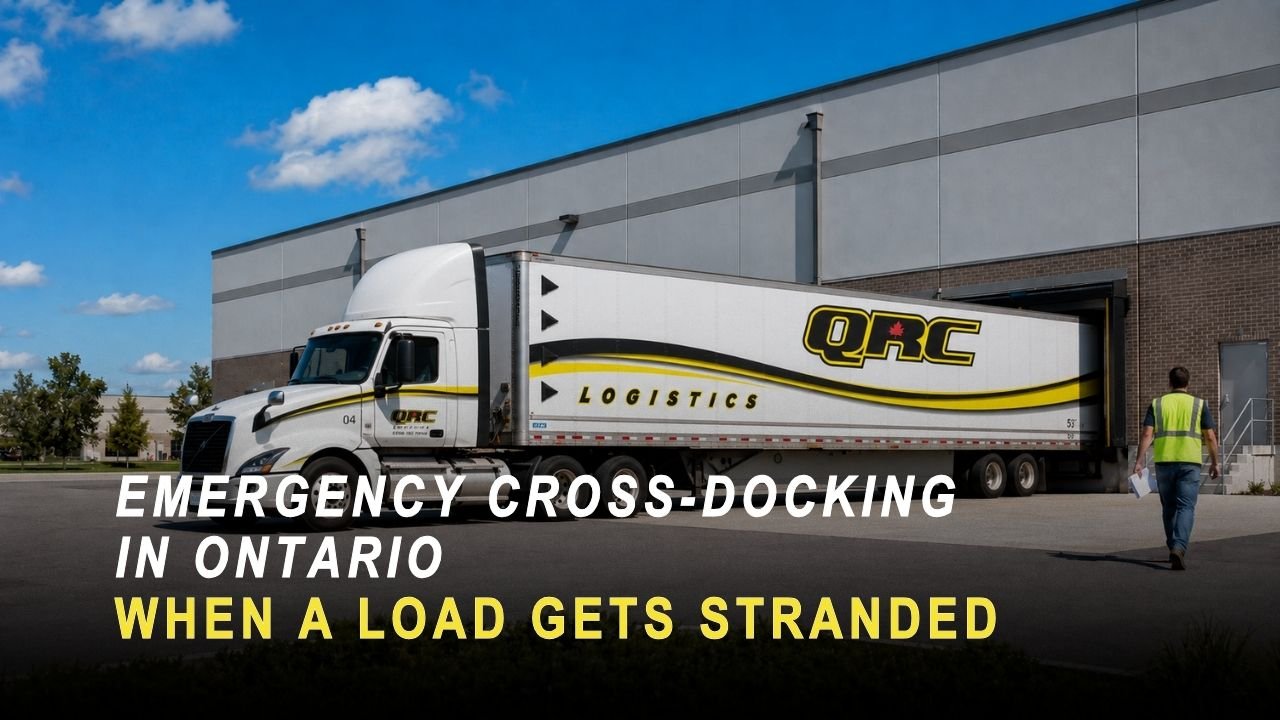
When the hours will not stretch, the move is often to hand the load to an Ontario delivery partner who protects the appointment and runs the delivery while the driver heads for parking or the border. That is emergency cross-docking in Ontario. Waiting or running a relay can work too, in narrower cases. This guide shows you when each one fits.
TL;DR
- A U.S. driver must follow Canadian hours-of-service rules while driving in Canada, and must still be legal to return to the U.S.
- Clearing customs does not reset the clock. Border inspections, Highway 401 and QEW traffic, and receiver waits all reduce the hours that are left.
- When the margin is thin, emergency cross-docking in Ontario can protect the appointment, as long as a nearby facility has capacity and the freight fits.
- Waiting works only when the appointment can move. A relay works only when a rested driver and matching equipment are already close.
Here is how the three moves compare. Do not weigh the local delivery rate against zero. Weigh the full cost of each choice, including detention, layover, equipment time, a missed backhaul, redelivery, and chargebacks.
| Factor | Wait | Relay | Emergency cross-dock |
| Best when | The appointment can move and the driver has legal parking | A rested driver and matching equipment are nearby | The appointment is fixed and hours or equipment fall short |
| Driver layover | Likely | Sometimes avoided | Often avoided |
| Missed backhaul | Possible | Reduced if a driver is available | Reduced if the driver can leave legally |
| Freight handling | None | Only if the freight is transferred | Usually required |
| Extra delivery charge | No | Possible | Yes |
| Smaller vehicle option | No | Only if arranged separately | Yes, when suitable |
| Protects the appointment | Only if the receiver reschedules | Possible | Possible when capacity is confirmed |
| Coordination needed | Moderate | High | Moderate |
| Proof of delivery | Stays with the original carrier | Must be assigned | Handled by the local delivery carrier |
Which Hours-of-Service Rules Apply After Entering Canada?
A U.S. driver does not keep running on U.S. hours-of-service rules alone after crossing into Canada.
The Federal Motor Carrier Safety Administration’s cross-border guidance says a U.S. driver must follow Canadian rules while operating in Canada. The driver must also stay able to comply with U.S. rules when returning home.
For most property-carrying drivers, the U.S. limit is 11 hours of driving inside a 14-hour duty window, after 10 hours off.
In Canada, a driver cannot drive after reaching any of these:
- 13 hours of driving in a day
- 14 hours of on-duty time in a day
- 16 elapsed hours after the qualifying off-duty period
Canadian rules also require at least 10 hours off duty in the day. The exact mix of driving, on-duty, elapsed, and cycle hours is what matters. The driver’s ELD and your safety desk have to work out what is actually left.
Do not treat Canada’s 13-hour driving limit as two free bonus hours. The driver still needs a legal plan for the work done in Canada and for any return to the U.S.
The Delivery Time Carriers Underestimate
Crossing the border is one step in the trip. The new Gordie Howe Bridge adds another Windsor-Detroit crossing option, but that does not tell you when the driver pulls away from the Ontario receiver.
The rest of the run can still include:
- Traffic on the way to or from the border
- Customs inspections
- Highway 401 or QEW congestion
- Early-arrival restrictions at the receiver
- Security check-in
- Waiting for a dock
- Unloading
- Paperwork and proof of delivery
- The drive to parking or the return crossing
The Canada Border Services Agency publishes commercial border wait times, but those numbers do not count the delays on the roads leading up to the crossing.
Receiver detention is the part carriers miss most. Under Canada’s Commercial Vehicle Drivers Hours of Service Regulations, time spent waiting while a vehicle is inspected, loaded, unloaded, or dispatched generally counts as on-duty time.
A driver can sit still for an hour and lose an hour of on-duty time.
Calculate the Real Delivery Margin First
Before you send the driver to the receiver, have dispatch confirm:
- The driver’s current location
- Remaining driving time
- Remaining on-duty time
- Remaining elapsed time
- Available cycle hours
- The receiver’s appointment
- Expected gate and dock time
- Unloading requirements
- Time needed to reach legal parking
- Traffic, weather, and construction
Then work the margin like this:
Remaining delivery margin = the driver’s most restrictive clock, minus travel to the receiver, expected receiver time, travel to parking or the return route, and a safety buffer.
Set that buffer from your own safety policy and the conditions that day.
If the plan only works when the highway, the gate, and the dock all run perfectly, it has no room left. That is usually when a local transfer makes sense, with two exceptions I flag below.
How Emergency Cross-Docking in Ontario Works
Stranded load right now? Call QRC Logistics at 1-800-430-7874 (toll-free) or 905-791-9004. Give us the crossing, ETA, and remaining hours, and we will tell you what our facility can take today.
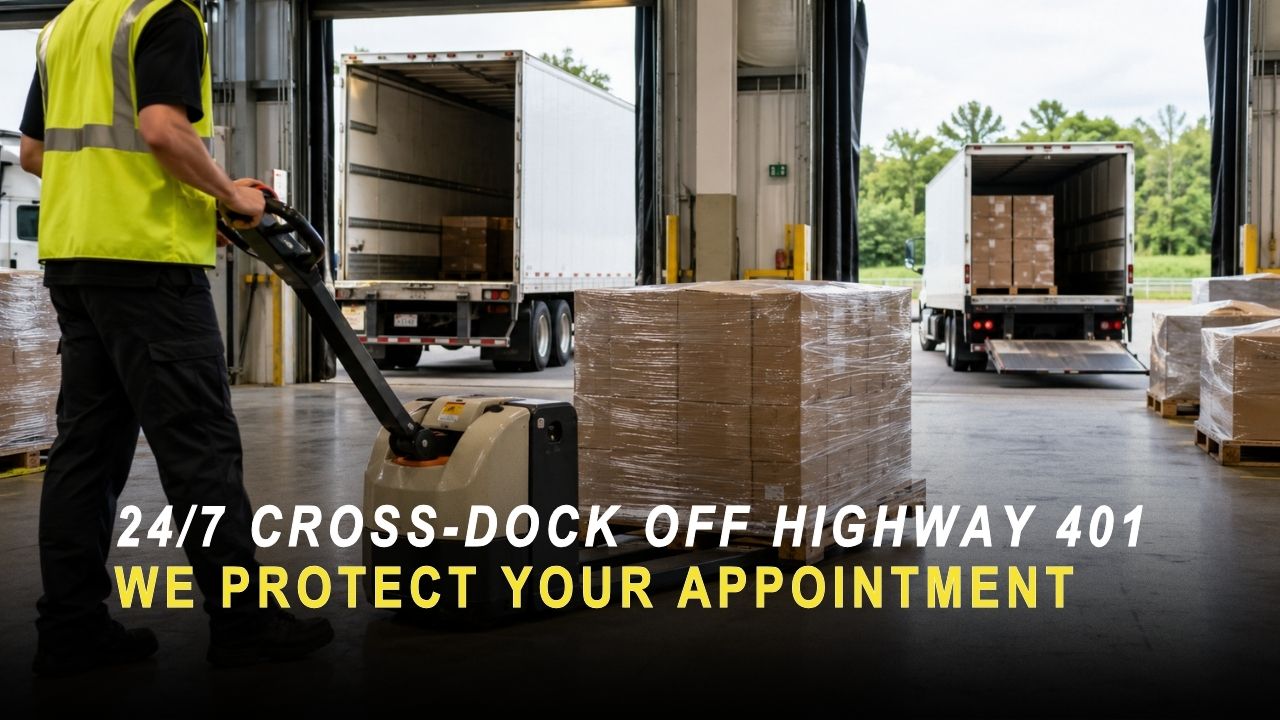
A local handoff takes the receiver visit off the U.S. driver’s assignment and puts the Ontario leg with a carrier who can hit the appointment.
At QRC Logistics, an inbound driver brings the freight to our 24/7 facility in our Halton Hills warehouse, where we are set up to take over cross-border loads for U.S. carriers. We receive the shipment, scan it, stage or consolidate it, book the receiver appointment, and run the delivery, including same-day and after-hours windows when the receiver allows.
The highway driver can then continue to legal parking or return south if the remaining hours allow.
What we can actually do depends on capacity, freight type, remaining hours, equipment, and the receiver’s availability. A local handoff helps most when:
- The receiver has a strict appointment
- The driver needs to protect a U.S. backhaul
- The freight must wait for a later delivery window
- The destination needs a smaller vehicle
- Delivery status and proof of delivery must go back to the U.S. carrier
A freight transfer adds a delivery charge and one more handling point, set against the full cost of a missed appointment.
Other Reasons a Load Gets Stranded
Driver hours are a common reason a U.S. load needs a fast transfer in Ontario, but not the only one. The same local handoff helps when:
- A receiver rejects the load
- Pallets shift or the load fails inspection
- A trailer breaks down
- The delivery appointment is already missed
- The equipment is wrong for the site
In each case, moving the freight to an Ontario facility protects the delivery while the highway carrier deals with the truck or the paperwork.
When the Trailer Does Not Fit the Destination
Sometimes the driver has the hours, but the equipment is the risk. This is another case for an urgent cross-dock.
A 53-foot trailer can reach Ontario and still be wrong for a tight commercial yard, a mall, a construction site, or a receiver with no loading dock. Other sites need a tailgate-equipped truck, a booked after-hours delivery, or specific unloading help.
QRC Logistics can assign courier vehicles, tailgate-equipped straight trucks, or dry vans through our local cartage and per-skid LTL service, based on the freight and the destination.
Switching to the right vehicle before the final stop can prevent an access failure that would otherwise use up the last of the driver’s hours.
When Waiting Is the Better Call
Waiting is the better call when the appointment can move and the driver has somewhere legal to sit. That holds when:
- The receiver can move the appointment
- The freight can stay secure in the trailer
- Legal parking or rest is available
- The delay will not hurt another committed load
- Your safety team confirms the required off-duty period
The costs add up: driver layover, parking, lodging, another day of tractor and trailer use, a missed backhaul, and a new appointment booking.
Some retailers will not move a missed appointment to the next morning, and the next opening can be days out.
When a Relay Is the Better Call
A relay is the better call when a rested driver is already close and the freight never has to be touched.
You might send a rested driver to take over the original tractor and trailer. Or a local tractor collects the loaded trailer. If the equipment cannot be swapped, the freight moves onto another trailer, and at that point you are transferring it anyway.
A relay works best when:
- A qualified driver is already close by
- The equipment matches
- The original trailer suits the destination
- Seal and insurance rules can hold
- Responsibility for the final delivery is clear
Confirm who controls the seal, who signs for the equipment, who reports exceptions, and who provides proof of delivery.
Sending a driver at the last minute can get expensive, and the relay fails if the replacement reaches the freight too late to save the appointment.
Planned vs. Emergency Cross-Docking
A planned transfer gives everyone more control. The inbound time is booked, the documents are ready, the freight profile is known, and the appointment is set before the U.S. driver leaves.
Emergency cross-docking starts after the hours have already become a worry. Now the facility has to confirm capacity, handling, equipment, and the receiver’s deadline all at once.
The earlier we know the ETA and the rest of the run, the more we can do.
What the Facility Needs Before the Driver Arrives
Send this as early as you can:
- Driver and dispatcher contact information
- Border crossing, current location, and ETA
- Trailer number and equipment type
- Customs release status
- Bill of lading and shipment references
- Pallet or piece count
- Freight dimensions and weight
- Stackability and handling limits
- Dangerous goods status
- Seal number and handling instructions
- Receiver address and contact
- Appointment number and delivery window
- Dock, tailgate, and site-access requirements
- Proof-of-delivery instructions
Also confirm whether the facility will receive the trailer, swap tractors, or unload the freight. Missing information just moves the delay from the highway to the dock.
Before you send a driver any farther into Ontario, get those details to QRC Logistics at 1-800-430-7874. We will confirm whether a 24/7 emergency cross-dock and local Ontario delivery can be supported.