
You want to put “order by 2pm, get it tomorrow” on your product page. Then you look at the service options and wonder whether you can actually hit the deadline from where your stock sits today. The question is not what overnight shipping is. It is whether you can promise it and keep it.
We have been shipping out of Halton Hills since 1978, and three things decide whether an overnight promise works in Canada: where your inventory sits, how early your cut-off is, and which delivery window you bought. Get those three right and overnight is straightforward. Get them wrong and you pay premium rates for a package that still arrives late.
The short version
- Overnight means the next business day. Order Friday afternoon and it arrives Monday, not Saturday. Tell customers that at checkout.
- Your order cut-off has to be earlier than the carrier’s pickup. Work out how long picking and packing takes on a busy day, then set the cut-off that far ahead.
- You pay for the size of the box, not just the weight. A 20 by 18 by 12 inch carton is billed as 32 lbs even when it holds 8 lbs of product.
What Overnight Shipping Means in Canada
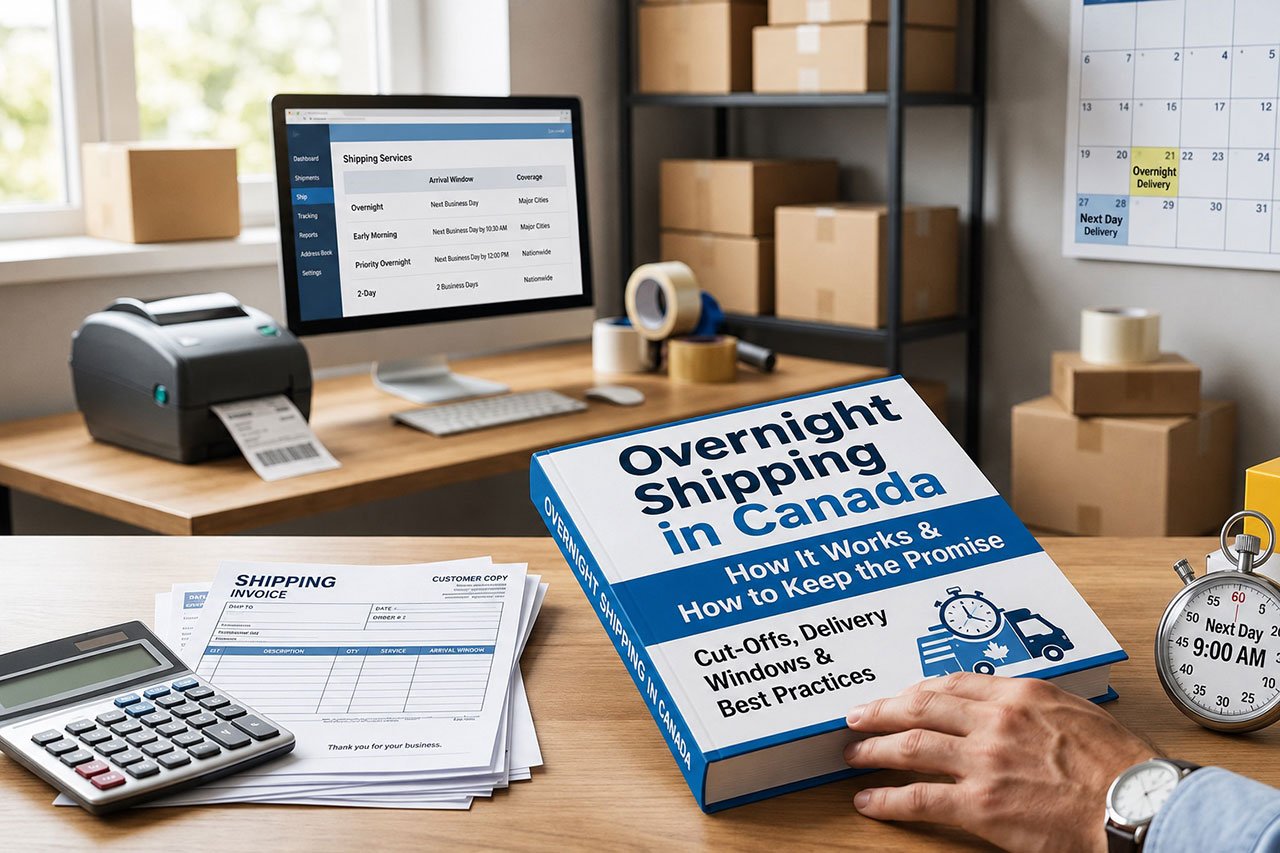
Overnight shipping means next business day, not 24 hours. A customer ordering Friday afternoon reads “overnight” and expects Saturday, while most carriers will deliver Monday. If your product page does not say “next business day,” you will spend Monday morning answering emails.
Overnight shipping and next-day delivery are the same thing, so there is no point agonizing over which phrase to use on your site. The delivery window is what actually differs between services.
You are not buying “tomorrow,” you are buying a time. A 9 a.m. commitment, a 10:30 a.m. commitment and an end-of-day commitment all arrive the next business day, but the price gap between them is large and plenty of shippers pay for a morning window their customer never needed.
Overnight Services by Carrier
Four carriers cover most Canadian overnight volume. Every service below delivers the next business day, so the thing that actually separates them is the time of day it arrives. The table is sorted earliest to latest.
| Arrives by | Service | Coverage and conditions |
| 9:00 a.m. | Purolator Express 9AM | Major cities. Requires an automated shipping system. |
| 9:00 a.m. | UPS Express Early | Many metropolitan areas. |
| 10:00 a.m. | FedEx First Overnight | Most metropolitan areas. |
| 10:30 a.m. | Purolator Express 10:30AM | Major cities. Requires an automated shipping system. |
| 10:30 a.m. | UPS Express | Most metropolitan areas. |
| Noon | Purolator Express 12PM | Major cities. Requires an automated shipping system. |
| Morning, no fixed time | FedEx Priority Overnight | Most metropolitan areas. FedEx does not publish a universal clock time for this service. |
| 3:00 p.m. | UPS Express Saver | Most metropolitan areas, commercial addresses only. |
| 5:00 p.m. | FedEx Standard Overnight | Most metropolitan areas. 8:00 p.m. to residential addresses. |
| 5:30 to 9:00 p.m. | Purolator Express Evening | Major cities. Requires an automated shipping system. |
| 9:00 p.m. | Purolator Express | All provinces and territories, the widest reach on this list. |
| Set by lane | Canada Post Priority | Between major urban centres. Committed in business days rather than a clock time, with an On-Time Delivery Guarantee. |
Every commitment above depends on the origin and destination. Purolator applies geographic and money-back-guarantee restrictions, Canada Post expresses Priority commitments in business days rather than one national clock time, and both UPS and FedEx direct shippers to confirm the exact commitment for a specific lane. Confirm yours before you promise anything, using the Canada Post postal-code tool and its delivery standards, the FedEx transit-time checker, the UPS 2026 Rate and Service Guide and Purolator’s guarantee conditions.
How an Overnight Order Actually Moves
Five things have to happen, and only two of them belong to the carrier. Your customer orders before your cut-off, then your team picks, packs and labels the shipment. More late overnight orders start here than at the carrier. If picking takes 90 minutes on a busy afternoon, your cut-off has to sit at least 90 minutes ahead of the truck, and a validated address prevents the exceptions that cost a full day.
From there the carrier collects and scans the package into that night’s overnight sort, moves it to a hub, then runs it to the destination city. Within Ontario and Quebec that leg is usually a truck. Across the country it goes on a plane, which is the expensive part. Finally it is delivered inside the window you paid for.
So your cut-off is not the carrier’s pickup time. It is the pickup time minus your slowest pick-and-pack cycle, not your average one.
What Drives Your Overnight Rate
Nobody publishes real overnight prices, because rates depend on your volume, your lanes and your carrier agreement. What you can control are the four things that move the number.
Weight and distance behave the way you expect. Heavier costs more, farther costs more, and carriers price distance in zones.
Size costs more than most shippers expect. Carriers charge for the space a package takes up, not just what it weighs. Purolator calculates dimensional weight as length by width by height in centimetres divided by 5,000 for kilograms, or divided by 139 for cubic inches and pounds, then bills whichever is higher, the volumetric weight or the scale weight. Canada Post works the same way, and so do UPS and FedEx.
A carton measuring 20 by 18 by 12 inches holds 4,320 cubic inches. Divided by 139, that is a dimensional weight of 32 lbs, so a box holding 8 lbs of product is billed at 32. You pay that difference on every order that ships in that carton.
Accessorial charges land after the quote. Fuel is applied as a percentage of the base rate and changes regularly. Residential delivery, oversize handling, address correction and Saturday service all get added separately. Ask for a full accessorial list before you compare two carriers, because a base-rate comparison will mislead you.
Your carrier agreement changes the rate more than anything else here. Consistent volume earns negotiated pricing, and the discount on a committed lane beats anything you find shopping one parcel at a time. Rate guides change annually, so rebuild the model each year.
Should You Offer Overnight at All?
Not every product needs it, and free overnight on a $40 order usually costs more than the order earns. Three questions sort this out.
Are you losing sales without it? Check your cart abandonment against delivery speed before you assume speed is the problem. Often it is shipping cost, not shipping time.
Can you charge for it? Paid overnight as an option at checkout carries no margin risk. Free overnight above a threshold works when the threshold sits above your average order value, not at it.
Does the product justify it? Replacement parts, medical supplies, anything holding up a job site or a production line. Those customers will pay real money for a morning window, and someone buying a candle will not.
If the answer is no on all three, put the money into holding inventory closer to your customers instead. Two-day delivery from nearby beats overnight from far away, and it costs less.
Where Overnight Shipping Goes Wrong
Relying on one carrier. The Canada Post labour disruptions of 2024 and 2025 produced a national strike and then rotating strikes, with service returning to normal in early 2026. Open a second carrier account now, while you have time to test the labels and rates, instead of during the next disruption.
Promising overnight to addresses that cannot receive it. Guaranteed windows apply to major cities and metropolitan areas. Rural routes and northern communities frequently fall outside them, so check the postal code before your checkout page makes the promise.
Setting the cut-off by wishful thinking. A 4 p.m. cut-off with a 4:30 p.m. pickup works until you get 200 orders in a day. Set it against your busiest day, not your average one.
Ignoring peak season. Peak-season surcharges land on parcel rates every year and transit slows even on guaranteed services. If your Q4 pricing uses Q2 rates, you are absorbing the difference.
Shipping air when ground already gets there. From our Halton Hills warehouse, next-day ground covers most of Southern Ontario, so air rates on a Toronto to Ottawa parcel buy you nothing.
How to Set It Up So You Can Keep the Promise
Put inventory close to the customers who need speed. Distance is the one thing better process cannot fix. If most of your orders go to Ontario and Quebec, holding stock in those provinces turns expensive overnight air into ordinary next-day ground.
Publish a real cut-off and defend it. Pick a time your warehouse can hit on its busiest day, then put it on the product page, in the cart and in the confirmation email.
Set up two carriers before you need two. Accounts, labels and rate shopping should already be live in your system before you need them.
Right-size your cartons. Given the dimensional weight math above, cutting two inches off a box on a high-volume SKU can drop it a full weight band.
Buy the window your customer actually needs. Most consumers are happy with end of day. Reserve the 9 a.m. and 10 a.m. tiers for parts, medical supplies and anything where a job site is waiting.
Measure the promise. Track the percentage of overnight orders that arrived on the committed day. Review it monthly, and give one person responsibility for the number.
Where We Fit
We run a 300,000 square foot warehouse in Halton Hills. Our own trucks cover Southern Ontario, which means next-day ground on lanes where others quote air. For everything else we rate shop across carriers rather than defaulting to one, and we set the cut-off around what our floor can genuinely hit.
If you are working out whether an overnight promise is realistic from where your stock sits today, contact to us. Bring your order volumes and your top five delivery provinces, and we can tell you quickly whether the promise holds.