
Most shippers I talk to start from the same assumption: a bigger carrier is a safer carrier. If a national network can cover the whole country, surely it can handle a few lanes in Ontario without any trouble. It feels like a careful choice.
For freight that stays inside Ontario, that instinct is usually backwards. The question that decides whether your freight arrives clean, on time, and into a retailer’s appointment window is not how big the carrier is. It is how the carrier is built. A regional Ontario LTL carrier and a national network are set up in two different ways, and the difference only shows up after the freight starts moving.
Let me explain that difference. If you want to know QRC’s Ontario service areas, which markets we run and what time freight lands in each, our Ontario LTL service areas page shows the delivery window for each market. This page is the step before that one. It is about how I would match the carrier to the freight you actually ship, before you ever look at a lane.
TL;DR
- Use a regional Ontario LTL carrier if your freight is concentrated in Ontario and goes to retailers with set appointment windows. You get fewer handoffs, tighter control over appointments, and same-day help when something goes wrong.
- Use a national network if your freight goes to many provinces with no real concentration in any one region. You get one carrier covering the whole country, reach into remote postal codes a regional carrier cannot serve, and one point of contact instead of a separate carrier in every region.
Use this table to find your freight profile and the carrier that fits.
| Freight profile | Best-fit carrier | Why |
| Ontario retail freight with delivery appointments | Regional Ontario LTL carrier | One team books and makes the receiving window, with fewer handoffs, which cuts re-deliveries and chargebacks. |
| Cross-Canada freight with no concentration in one region | National network | One carrier reaches every province, including areas a regional carrier does not run. |
| Recurring GTA and Southern Ontario lanes | Regional Ontario LTL carrier | The trucks run those lanes daily, so you get steady transit times and same-day or overnight options. |
| Remote postal codes | National network | Terminal coverage reaches addresses outside a regional carrier’s service area. |
| Cross-border LTL into Ontario | Regional Ontario LTL carrier for the Canadian leg | One team moves the freight from the border through Ontario LTL and final mile, instead of a second national network for the last part. |
Two Carrier Models Built for Two Different Jobs
Start with what each carrier is set up to do, because they are not trying to do the same thing.
A national LTL network is built to reach everywhere. Its job is to get a shipment to any postal code in the country, and it does that by moving freight into terminals, running it between them on long-haul, and sending it back out at the other end. Wide coverage is the whole point.
A regional LTL carrier in Ontario is built to run the same ground every day. Its job is to cover one region with its own trucks, over and over, until it knows the receivers, the docks, and the streets well. Doing the same work well is the whole point.
Neither one is better. They are built for different work. The mistake I see most often is a shipper handing tight, local, repeating freight to a carrier built for distance, then wondering why the freight keeps running into problems. In Ontario, the freight that goes wrong is rarely freight that needed a national network. It is local freight that got run through a system built for long distance.
So the real question is not which carrier is bigger. It is what kind of work your freight actually is, and which carrier is built for it.
Count the Handoffs
If you only take one idea from this page, take this one. Count the handoffs.
Here is the path your freight takes in a national network. A pickup agent collects it. It goes to an origin terminal. It rides line-haul to an Ontario terminal. A local delivery agent runs the last stretch. That is four or five touches, and often three different companies, between your dock and the receiver.
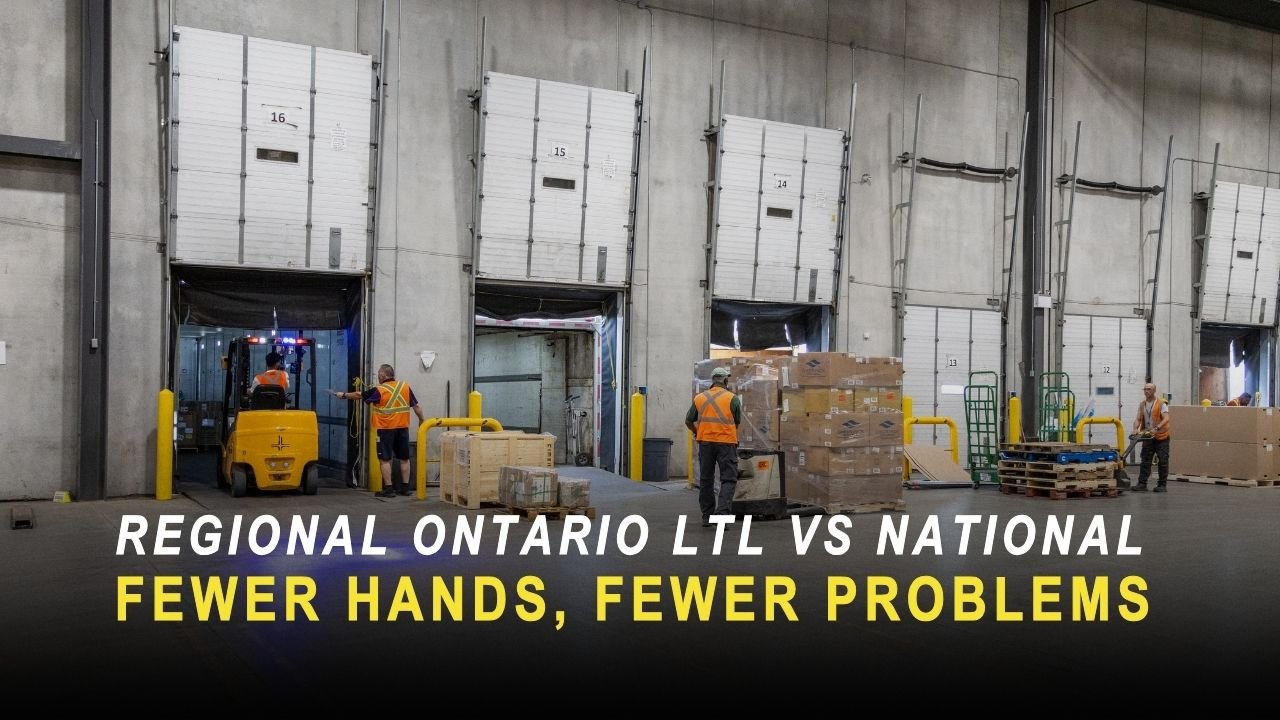
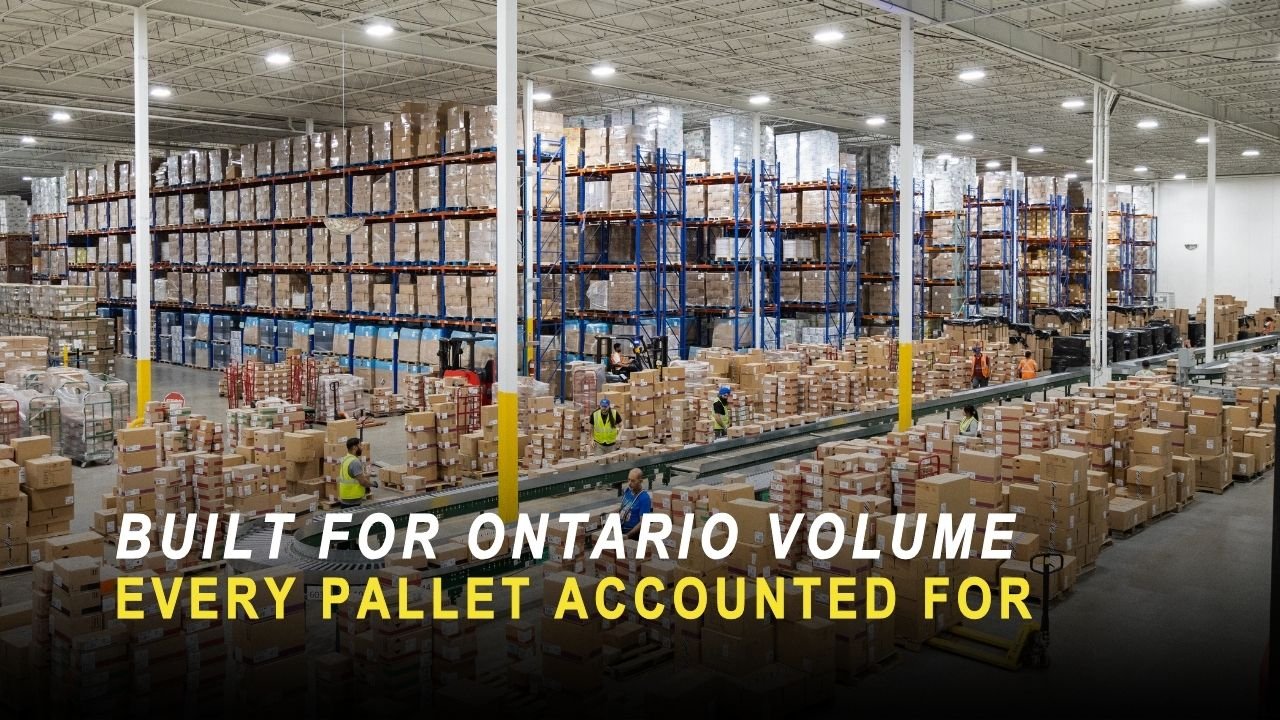
Now here is the regional path. One hub, in our case a 300,000 square foot building in Halton Hills close to the major GTA corridors, one team, pickup to delivery. The pallet gets handled when it is loaded and when it is delivered. That is most of it.
Here is the warning, and it comes from running freight through Ontario for a long time. In my experience the shipment that shows up damaged or short is almost always the one that got rehandled at a terminal it did not need to pass through. Every handoff is a place a skid gets re-sorted, re-stacked, or mis-routed. It does not matter how good each terminal is. What matters is how many times the freight gets handled.
That is the tradeoff, stated plainly. More terminals give you reach. They take away control over what happens to the pallet in between. If your freight stays inside Ontario, every extra handoff adds risk without adding anything you need.
What Running the Same Ground Every Day Gets You
A carrier that covers one region well, instead of spreading across the whole country, gives you things that look small at first and matter a lot day to day.
A carrier that already runs GTA and Southern Ontario lanes every day can offer same-day, overnight, and short-window delivery, because the truck is going there anyway. A national network cannot change its long-haul schedule for one shipper. The schedule is built for the whole country, not your lane.
Off-hours freight works the same way. Night, weekend, and event delivery for a time-sensitive launch is workable for a regional operator with local trucks and local drivers. It is hard for a terminal network that moves on a fixed schedule.
Running the same ground also gives you steady transit times. The same lane, run the same way, by the same operation, arrives at a predictable time. A national network is set up for the whole country. A regional carrier is set up for your lane, because your lane is most of what it does.
And then there is local knowledge. Knowing the receivers, the docks, the access quirks, the streets where a 53 foot trailer simply will not go. That is not something a national network can add on. It comes from running the same ground for years.
Appointments and Retailer Rules You Cannot Miss
If your freight goes into retail, this section matters most.
Ontario retail delivery appointments are tight. Distribution centres and stores book narrow receiving windows, and they hold you to them. Miss one and you do not just reschedule. You face a re-delivery, and often a chargeback from the retailer on top of it. For a brand shipping into a large retailer, that adds up quickly, and it rarely shows on the invoice as what it really is.
Here is the structural point. Whoever controls the truck controls the appointment. In a national network, the local delivery agent answers to the terminal’s schedule, not to your retailer’s window. The appointment is one job among thousands. In a regional model, the dispatcher who booked the appointment runs the truck that has to make it. The accountability stays in one place.
There is a compliance side to this too. ASN formatting, retailer-specific labels, pallet builds done to spec, chargeback prevention. That is knowledge a carrier builds by running retail freight into the same receivers over and over, not by covering a wide map.
So if your freight goes into appointment-driven retail, your choice of carrier is a compliance decision before it is a transit decision. Treat it that way.
When Something Goes Wrong, Who Picks Up the Phone
Every carrier looks fine when the shipment goes through clean. You find out who you hired when something breaks.
It is 4 PM and a receiver rejects your load. Maybe a dock is closed, or the address was wrong. With a national network, you call a toll-free line, open a ticket, and wait your turn behind every other shipper having a hard afternoon. The person who answers does not know your freight. With a regional carrier, you reach a dispatcher who already knows your lane and can move a truck before the day ends.
Tracking is no different. A national network gives you a status update when your freight passes through a terminal. A regional carrier scans the shipment and sends proof of delivery from the same people who loaded it, so you know what actually happened, not just where it was last scanned in someone else’s system.
This is the part shippers underrate. What you really need is the ability to give your own customer a straight answer fast. On a good week it never comes up. On a bad one it is the whole job.
When a National Carrier Is the Right Call
A fair Ontario LTL carrier comparison has to say plainly when the national model wins, because it does.
If you distribute coast to coast, to every province, with no concentration in any one region, a national network is built for exactly that. One-off shipments to remote postal codes are the work it does best. When that wide reach matters more than running the same ground every day, a regional carrier cannot be your only answer, and you should not force it to be.
I will be direct about our own model, because it is the proof this comparison is honest. QRC is asset-based in Ontario. We run our own trucks here. For the rest of Canada, we reach it through a partner-carrier network, not our own terminals. We do not pretend to own a national fleet. That admission is the point. A carrier that tells you which lanes it owns and which it partners is a carrier you can plan around.
When a Regional Ontario LTL Carrier Gives You More Control
The other side of this is just as clear. A regional carrier gives you more control when your freight is concentrated and recurring inside Ontario, goes to retailers with appointments and compliance rules, and fits the LTL band where it should be handled as few times as possible.
US shippers get one more reason. Once your freight crosses the border, it still has to reach Ontario. This is cross-border LTL into Ontario, and you do not want to hand that last part to a second national network. We take the freight on the Canadian side and run it through LTL and final mile in Ontario as one step, with one team accountable from the border to final delivery. We hold CIFFA membership and PIP-approved handling. The handoff stays in one place instead of spreading across vendors.
Control comes down to these things. Fewer handoffs. A named contact. Owned trucks. A dispatcher who knows the lane.
A Side-by-Side Checklist Before You Sign
Ask both carriers the same questions. The answers separate the models faster than any sales pitch.
- How many times will my freight be handled between pickup and delivery?
- Do you own the trucks that run my Ontario freight?
- Who is accountable when a retail appointment is missed?
- What is your chargeback record on retail appointment freight?
- When there is a problem, do I reach someone who already knows my lane?
- Can you deliver on a weekend or overnight when a launch needs it?
If a carrier cannot answer these cleanly, that is your answer.
When You Need Both
Some shippers fit cleanly on one side. Plenty do not. If your freight is concentrated in Ontario and goes into retail, a regional Ontario LTL carrier should own that part. If you also ship across the country, a national network handles the rest. When your freight splits like that, the real question is not which model to pick. It is how to run both without losing accountability where they meet.
That is how we are set up. Our own trucks in Ontario out of Halton Hills, with a Montreal terminal supporting Quebec lanes. Partner coverage for the rest of Canada. And a single accountable cross-border handoff so freight entering Canada moves through one operating team instead of many separate vendors. One relationship across warehousing, Ontario LTL, final mile, and returns, rather than four contracts and three phone numbers when something goes wrong.
Get a Straight Answer on Your Freight
Send us your Ontario lanes and appointment requirements, and we will tell you whether a regional Ontario LTL carrier, national coverage, or a blend of both fits your freight best. The more you share, pickup and delivery postal codes, pallet count, appointment rules, and how often each lane runs, the more exact that answer will be.
For how a regional Ontario LTL carrier runs in practice, see our guide to Ontario LTL and final-mile delivery.