You ship pallets and cases to other businesses. You want a 3PL that stores your stock, builds the pallets right and gets them to your customer’s dock on time.
The trouble is that every 3PL website sounds the same. National coverage. Advanced technology. Tailored solutions.
So we compared five 3PL companies in Canada on what they actually publish. You will see where each one operates, what it does well and where it falls short.
Including us.
Editorial disclosure: QRC Logistics publishes this guide and is one of the five. Nobody paid to be included. We held all five to the same four checks, using what each company published as of October 2026.
TL;DR
- No 3PL wins for everyone. Pick the one built for your freight.
- Ask where the warehouses are. Not just where they deliver.
- For B2B, ask about pallets. Pallet builds, delivery appointments and EDI (orders and shipping data sent electronically between systems) matter more than pick rates.
- Send everyone the same numbers. That is the only way to compare quotes.
3PL Companies in Canada at a Glance
The order is not a ranking.
| Provider | Best for | Main locations |
| McKenna Logistics Centres | National chain suppliers | Mississauga and Toronto |
| QRC Logistics | B2B pallet distribution and final mile | Halton Hills warehouse, Montreal terminal |
| Hyperlink Logistics | Ecommerce fulfillment | Four GTA sites |
| GX Transport | Moving freight across provinces | Mississauga (a carrier first) |
| Newl Group | Warehousing and freight with one team | Mississauga, plus Charlotte, NC for U.S. stock |
Which 3PL Fits Your Freight?
Find what you mainly ship. Then read those profiles first.
| If you mainly ship… | Start with |
| Pallets and cases to business customers | QRC, Newl, McKenna |
| Fragile or high-value goods on delivery appointments | QRC |
| Full truckloads across provinces or the border | GX Transport |
| Imported containers | Newl, Hyperlink |
| Several B2B channels from the same stock | QRC, Newl, McKenna |
| Stock in both Canada and the U.S. | Newl |
How We Compared Them
We picked five mid-market providers that run different models. Their Canadian locations sit around the GTA and Montreal, so this guide fits shippers serving Ontario and Quebec first.
We checked the same four things for every company:
- Where it operates: Which locations it runs itself, and where it relies on partner carriers.
- What it does well: The freight and services it is built for.
- Proof: Performance numbers, certifications and named clients it publishes.
- Watch for: Its main limit, and what to ask before you sign.
McKenna Logistics Centres: Best for National Chain Suppliers
McKenna is a family business that has stored consumer goods in the GTA since the 1950s. It ships cases and pallets into national chains, with the labelling those accounts demand.
Where it operates: Two GTA warehouses: 105,000 sq ft in Mississauga and 32,000 sq ft in Toronto. Everything outside the GTA moves on carriers.
What it does well: Cross-docking, kitting, display builds, price ticketing and French labelling. It names its systems, Made4Net and Techdinamics, and publishes its EDI capability. It offers ecommerce fulfillment too.
Proof: An IWLA member with case studies. Its homepage reports a 99.89% perfect order rate, self-reported with no period given, and its KPI page lists the measures it tracks.
Watch for: It has no warehouse outside the GTA, and we could not find a white glove service. Ask about current capacity and out-of-province delivery.
QRC Logistics: Best for B2B Pallet Distribution and Final Mile
This is us. We store your inventory and deliver it on our own trucks.
We are built for recurring B2B freight: wholesale orders, regional pallet runs and deliveries booked into your customer’s receiving window.
Where it operates: Our 300,000 sq ft warehouse in Halton Hills and our Montreal terminal in Saint-Laurent, which stores inventory and handles pick and pack. Our own LTL trucks run across Southern Ontario and Greater Montreal. Beyond that, we use partner carriers.
What it does well: Per-skid LTL, pallet builds, ASNs (advance ship notices that tell your customer what is on the truck) and EDI, appointment delivery and final mile, including inside delivery and white glove. You get daily shipping and inventory reports, real-time proof of delivery and a monthly scorecard.
Proof: In business since 1978, open 24/7, PIP-approved and a CIFFA member. We publish a 98.9% on-time rate, self-reported, and a 99.5% inventory accuracy target.
Watch for: We do not hold inventory in Western or Atlantic Canada. Ask which delivery legs move on our trucks and what the written service agreement covers.
Hyperlink Logistics: Best for Ecommerce Fulfillment
Hyperlink has fulfilled orders in the GTA since 1989. Its own blog says it is now part of Bulletproof Logistics, a Quebec 3PL.
Its website leads with ecommerce and Amazon FBA.
Where it operates: A Vaughan head office and sites in North York, Mississauga and Woodbridge. Its pages give different square footage totals, so ask for current capacity.
What it does well: Online and marketplace orders, Amazon FBA prep, container unloading and same-day GTA delivery. For B2B, it offers pallet storage, case picking and cross-docking, with API and EDI links.
Proof: Its security is documented: 24-hour monitoring, cameras and swipe-key entry. We found no published performance figures, certifications or case studies.
Watch for: Its website puts ecommerce first, and the new ownership may change its services. Ask what share of its volume is B2B today.
GX Transport: Best for Moving Freight Across Provinces
GX is a Mississauga trucking company. It runs LTL, truckload, dedicated fleets and cross-border freight, all of it B2B.
Pick GX when your problem is moving pallets, not picking orders.
Where it operates: Head office and dock in Mississauga. Its own LTL service runs into Ontario, Quebec, Manitoba, Saskatchewan, Alberta and BC, plus the U.S.
What it does well: LTL and truckload, dedicated fleets, after-hours delivery, and temperature-controlled and hazmat freight.
Proof: Running since 1997. GX reports several Nissan logistics awards for warehousing and delivery to Nissan’s Canadian dealers, and a 2025 Shipper’s Choice Award for LTL.
Watch for: GX is a carrier first. It has no warehousing service page and names no WMS (warehouse management system) or EDI system. We found no published performance figures. Ask for a demo and how much warehouse space it has.
Newl Group: Best for Warehousing and Freight With One Team
Newl runs warehousing and freight together for importers, manufacturers and distributors. It suits you if you want one partner from the container to your customer’s dock.
Where it operates: One 55,000 sq ft warehouse in Mississauga with eight loading docks, plus a hub in Charlotte, North Carolina, for U.S. stock.
What it does well: Container unloading, case and pallet picking, cross-docking, GTA trucking and cross-border freight. Orders come in by API, EDI or spreadsheet.
Proof: A Partners in Protection certified facility and more than 35 years in operation, according to Newl. It publishes 99.24% inventory accuracy and 98.97% order accuracy, self-reported with no period given.
Watch for: All of its Canadian stock sits in one Mississauga building, so space at peak is the thing to confirm. Ask how many pallet positions are free and which freight runs on Newl’s own trucks.
Omnichannel 3PL Logistics in Canada
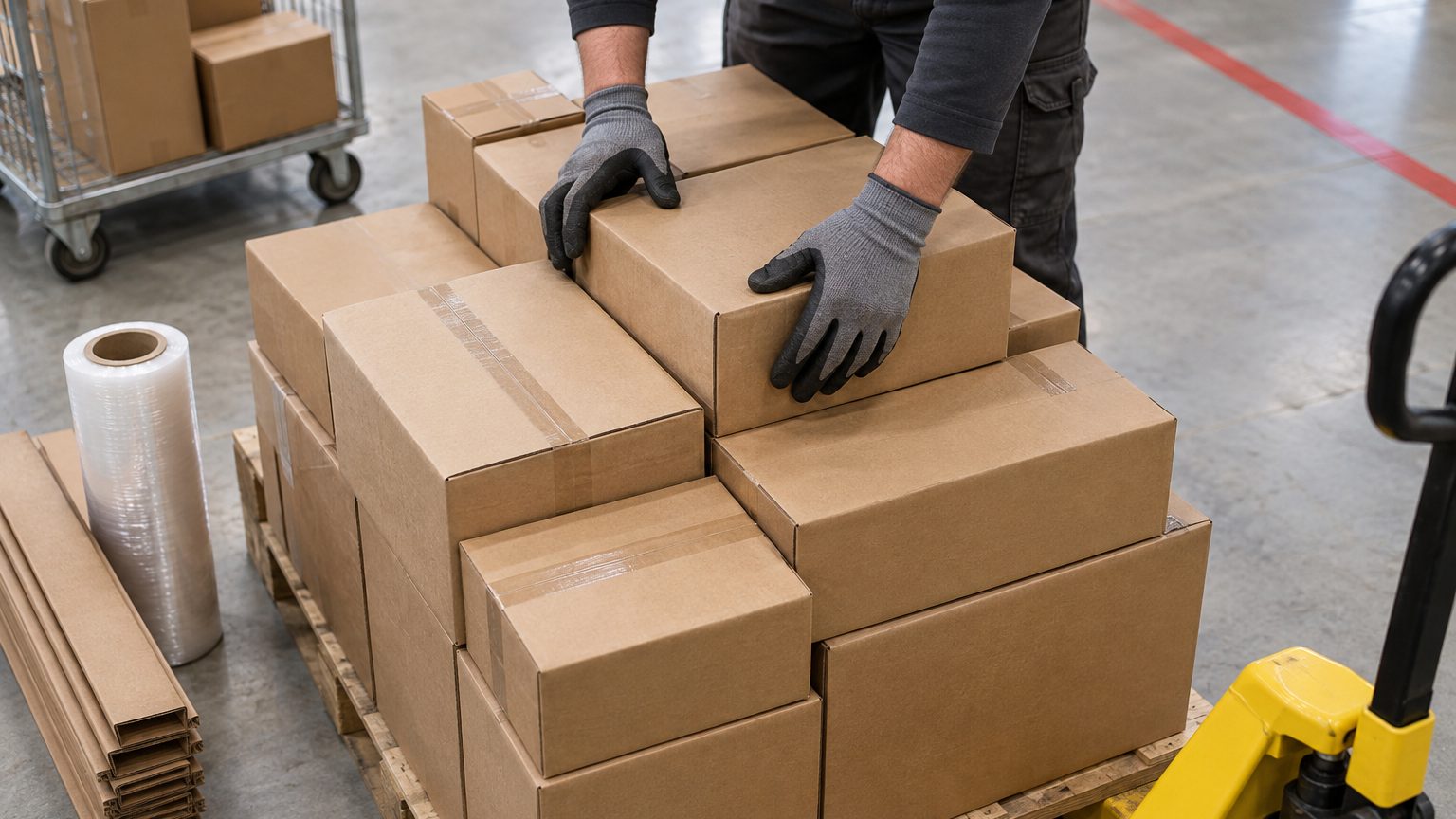
Many B2B shippers sell through more than one channel. Full pallets go to distributors. Mixed cases go to dealers. Smaller orders go straight to business customers.
An omnichannel 3PL serves all of them from one stock of inventory.
Each channel has its own order size, labels and delivery rules. A 3PL that builds full pallets well can still get mixed-case orders wrong.
Ask each provider for these numbers from the last quarter:
- Order accuracy by channel: What percentage of full-pallet orders and mixed-case orders shipped without an error?
- Fill rate: What percentage of B2B orders shipped complete on the first attempt?
- On-time appointments: What percentage of delivery appointments did they make on time?
- Dock-to-stock time: How many hours from receiving your freight until it is ready to ship?
- Short shipments: How many orders shipped short because stock was held for another channel?
Ask whether these numbers are tracked, and whether the provider can share a recent sample report.
What to Include in Your 3PL Quote
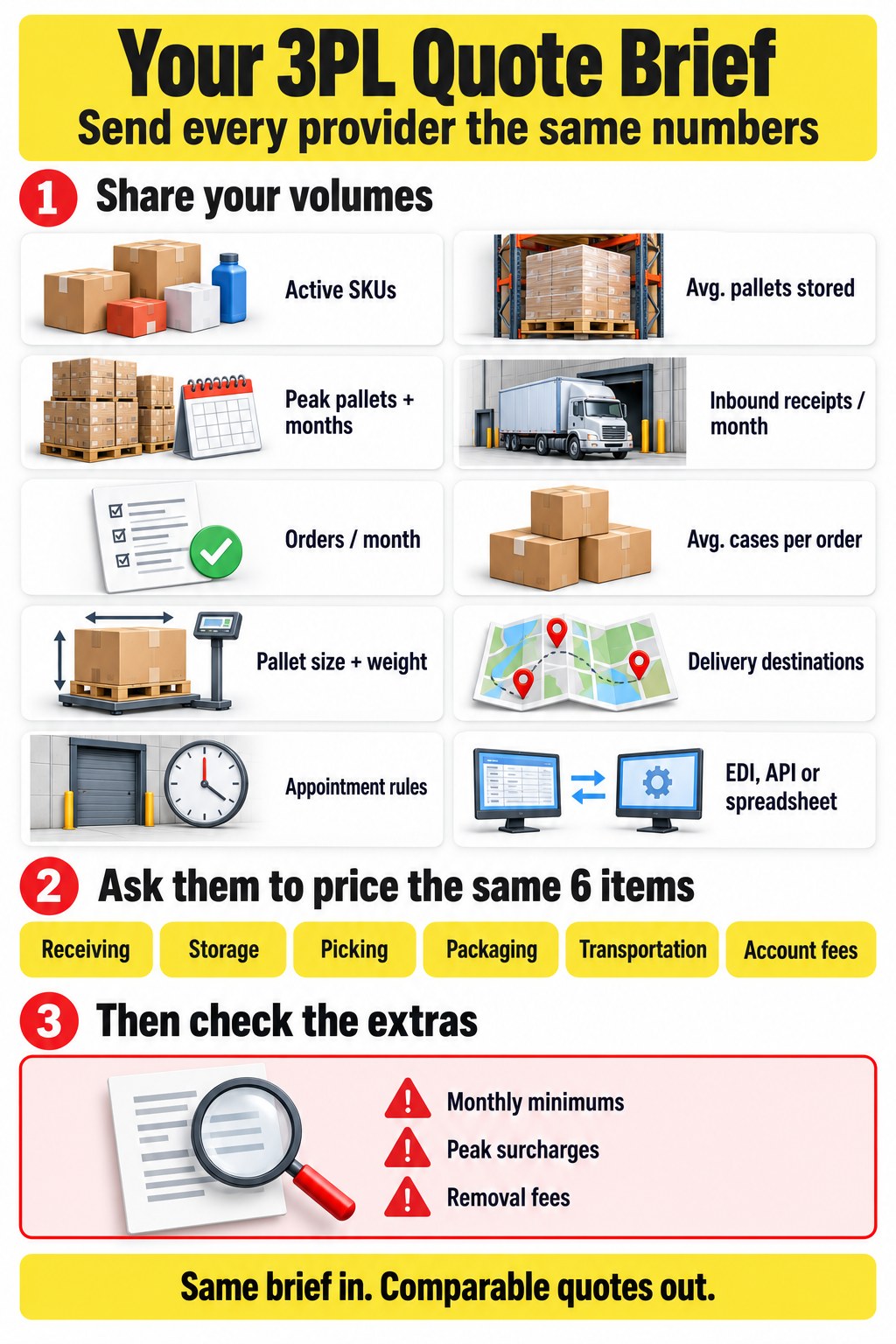
Most 3PLs price each account separately, so there is no standard price list. What you control is the brief you send.
Send every provider the same quote brief:
- Active SKU count
- Average pallets stored per month
- Peak pallets stored, and which months
- Inbound receipts per month
- Orders per month
- Average cases per order
- Typical pallet dimensions and weights
- Delivery destinations by province or city
- Delivery appointment requirements
- How orders reach the 3PL: EDI, API or spreadsheet
Ask each provider to price the same items: receiving, storage, picking, packaging, transportation and account fees.
Then ask about the extras. Monthly minimums, peak surcharges and removal fees can cost more than the rates. Our guide to the hidden costs of 3PL services in Canada breaks them down.
How to Choose Your 3PL
Start with what is going wrong today. Late deliveries, picking errors and no inventory visibility each need a different fix.
Then follow these five steps:
- Shortlist two or three from the tables above.
- Send each the same quote brief from the list above.
- Ask for dated performance results, not promises.
- Read the exit terms before the rates.
- Start with one product line for a quarter before you move everything.
Get a Straight Answer on Fit
If you ship pallets or B2B orders in Ontario or Quebec, send us your volumes and delivery regions.
We will tell you honestly whether we are the right fit. And if we are not, we will tell you that too.