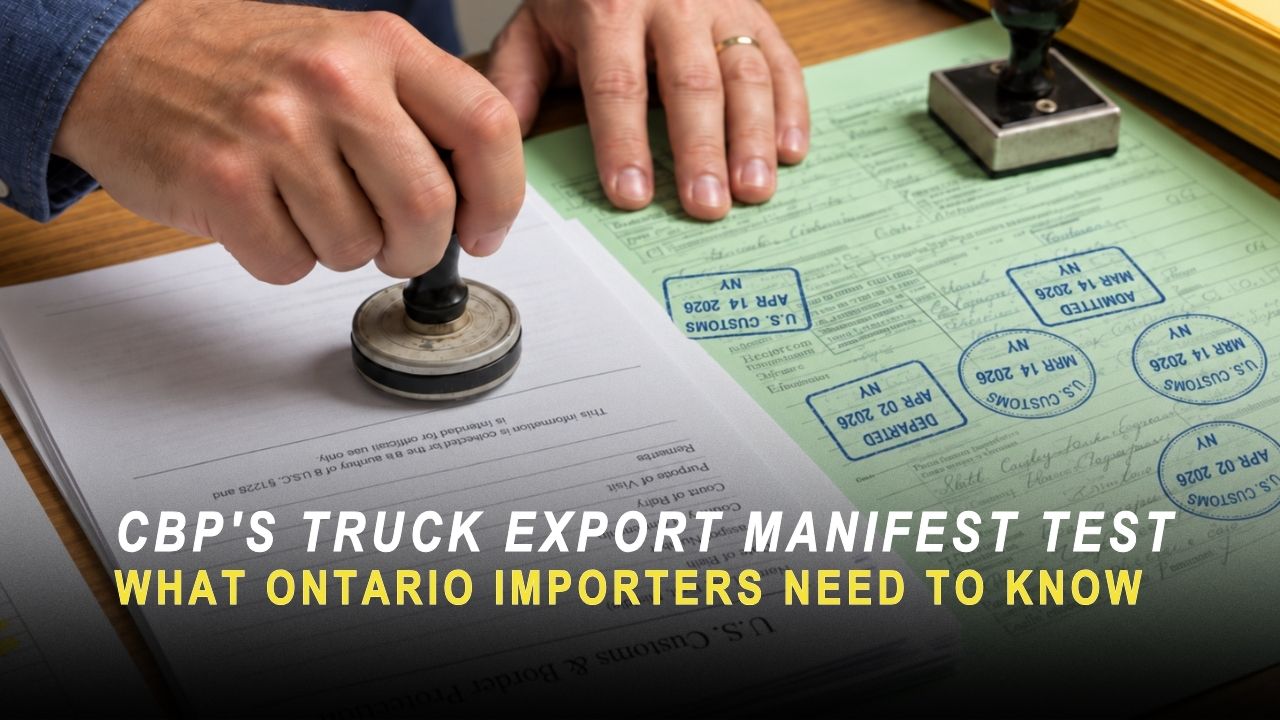
Is your next U.S. shipment headed to an Ontario retailer with a delivery window already booked?
To protect that window, you need two things from the U.S. side: a firm arrival time and final shipping details. U.S. Customs and Border Protection (CBP) is about to make the second one more time-sensitive.
Its new truck export manifest test asks participating carriers to file shipment details at least 24 hours before freight leaves the U.S. If your carrier takes part, your supplier has less room for last-minute changes.
TL;DR
- Starting October 23, 2026, up to nine carriers will test filing U.S. truck export details earlier.
- They must send seven shipment details at least 24 hours before the freight leaves the U.S.
- Ask your U.S. carrier whether your load is included.
- If it is, confirm the goods, carton count, weight and consignee with your supplier early.
Is Your Shipment in the CBP Truck Export Manifest Test?
CBP’s electronic export manifest test is voluntary. It is limited to nine truck carriers moving freight out of the United States. CBP may initially limit the test to a small number of ports.
So start with one question for your U.S. carrier: “Does the test cover this shipment?”
If it does, the carrier files in two steps through ACE, the U.S. system for trade filings:
- The initial details: due at least 24 hours before the freight leaves the United States
- The complete manifest: due no later than two hours before the truck reaches its final U.S. port of export
This is a carrier-filed export manifest. U.S. shippers still have to meet any export filing rules that already apply to their goods. CBP plans to use the results to shape a future rule, but it has not set a date or a final filing window for all truck carriers.
What Needs to Be Ready 24 Hours Ahead
The carrier needs seven details for the first filing:
- The bill of lading number
- The cargo quantity and unit, such as the number of cartons
- The total cargo weight
- A precise description of the goods
- The shipper’s name and address
- The Canadian consignee’s name and address
- An AES exemption statement, if one applies
Two of these need a closer look.
Count the cartons, not just the pallets. CBP asks for the lowest external packaging unit. If 10 pallets hold 200 cartons, the quantity is 200 cartons. A booking that says only “10 pallets” is missing what the carrier needs to file.
Name the goods. CBP will not accept descriptions such as “general cargo” or “freight of all kinds.” If the shipper gave the carrier a six-digit Harmonized Tariff Schedule number, the carrier adds it to the description.
As the Ontario importer, check that the consignee on the bill of lading matches the party receiving the goods. This matters most when your company buys the goods but a separate warehouse receives them.
Watch Orders That Change on Pickup Day
Here is where the timing gets harder.
A U.S. supplier books three pallets for an Ontario retail order. Its warehouse is still picking, so the final carton count and weight won’t be known until the driver arrives. Another purchase order might be added to the load.
The carrier has a pickup request, but no firm details for the early filing.
If your carrier is in the test, ask the supplier when it will know exactly what is shipping. Any change after the first filing also needs to reach the person managing the manifest.
CBP may ask for more information or hold cargo it flags for review. Participating carriers must also be able to act on a “Do Not Load” instruction. That does not mean every corrected carton count will delay a truck. It does mean the carrier needs clear details and a contact who can answer questions while the freight is still in the U.S.
Can You Still Book a Same-Day U.S. Pickup?
Yes, in some cases.
The 24-hour deadline counts back from when the freight leaves the U.S., not from pickup. Confirm with the participating carrier whether its filing and planned U.S. departure meet the test deadline.
If your supplier packed the order yesterday and can confirm the goods, cartons, weight and shipping parties today, a same-day pickup may still fit a later border departure.
If the supplier won’t know what is on the truck until the driver arrives, get the carrier’s departure plan first. Do this before you book the Ontario receiving dock or promise a store a delivery time.
On a truck collecting several orders, check when each order will be final. One late addition can change the load details the carrier needs.
Canada Has a Separate Filing Deadline
Under Canada’s highway ACI (Advance Commercial Information) and eManifest rules, cargo and truck information generally must reach the Canada Border Services Agency and be validated at least one hour before the truck arrives at the first Canadian port.
That filing is separate from the CBP truck export manifest test. Confirm who handles it for your load.
When the Crossing Time Changes
When a U.S. carrier hands freight to QRC at our Halton Hills operation, we receive and stage it for Ontario delivery. Our shipment milestones show which orders have arrived and which have moved on to the next step.
If the crossing slips, the received scan confirms what is already on our dock. For orders still on the way, we need an updated arrival time from the carrier. Together, those details help us decide whether a booked retail appointment still works or needs a new time.
“Delayed at the border” leaves a receiving team guessing. A new arrival time and a list of affected orders let them decide whether the dock time and outbound delivery still work. So give your Ontario receiving team one contact for arrival updates.
Five Questions to Send Before You Book
For any U.S. shipment with a tight Ontario delivery window, send these:
- To the carrier: Is this load part of the CBP truck export manifest test?
- To the supplier: When will the final carton count, weight and description be ready?
- To the supplier: Does the consignee on the bill of lading match the party receiving the goods?
- To the supplier: Who will tell the carrier if the load changes?
- To the carrier: Who will send us a new arrival time if the crossing changes?
At QRC, we connect inbound handoffs at Halton Hills with Ontario LTL and retail delivery. Once your carrier and supplier answer these, you can book the Ontario handoff against one plan, with time to adjust if the load changes.
Already moving U.S. freight into Ontario and missing retail windows after late crossings? Book a call with QRC and tell us about your freight. We will come prepared.