
Your pallet leaves the warehouse on Tuesday. Tracking shows it moving. The receiver still rejects it on Thursday because the truck missed its appointment.
Now your operations team has to figure out where the delay began.
I have seen plenty of late deliveries blamed on the driver when the problem started much earlier. The order was released late. The pallet details were wrong. The appointment was requested but never confirmed. The truck arrived without the right equipment to unload.
Find the real cause and you stop it from following the next shipment.
TL;DR
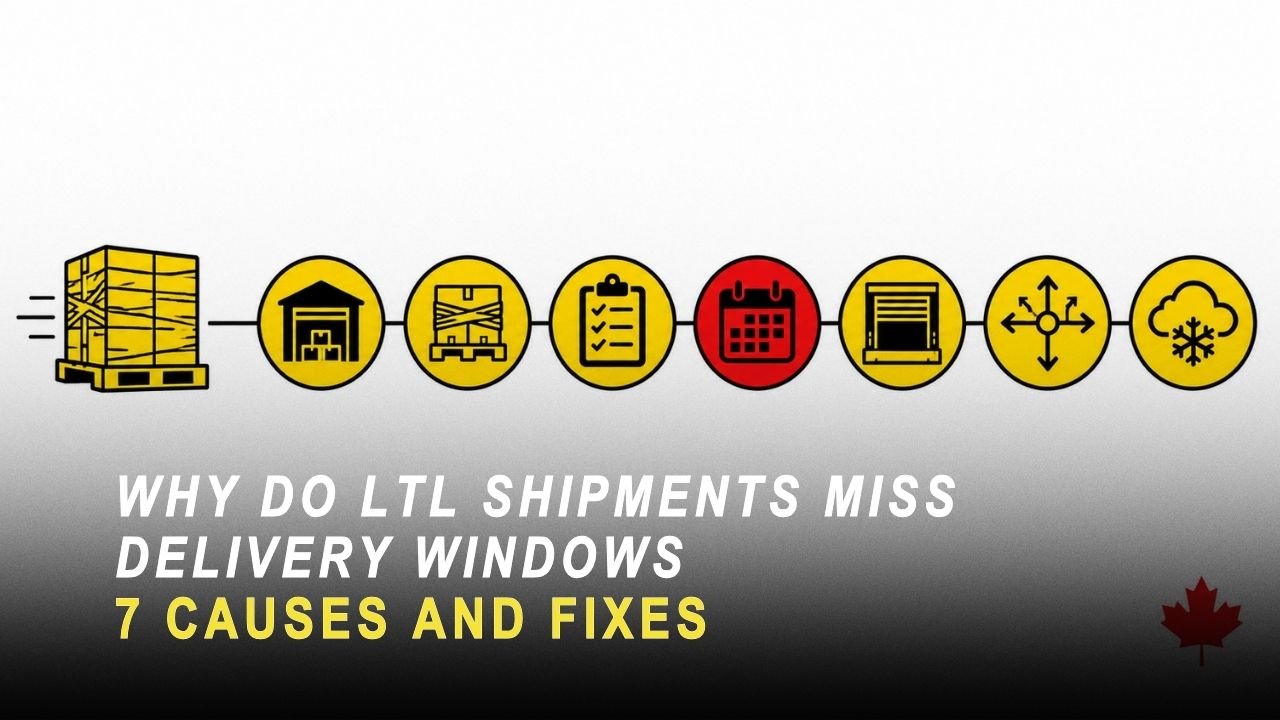
Most late LTL shipments do not start with the driver. They start earlier, at the release, the pallet details, or the appointment. Below are the seven usual causes and how to prevent each one.
| # | Cause | The quick fix |
| 1 | Missed the pickup cutoff | Confirm three separate times: order release, pallet ready, pickup route close |
| 2 | Wrong pallet information | Measure and weigh the finished, wrapped load before booking |
| 3 | Delivery requirements never reached dispatch | Call ahead about dock, equipment, and receiving hours |
| 4 | Appointment requested but not confirmed | Treat it as booked only with a confirmed date, time, and reference number |
| 5 | Receiver kept the truck waiting | Log arrival, check-in, and unload times separately |
| 6 | Too many handoffs | Ask how many carriers and terminals will touch the freight |
| 7 | Weather, roads, or capacity | Leave recovery time and check 511on.ca before time-sensitive runs |
What Counts as a Missed Delivery Window?
First, check what was promised.
An estimated transit time tells you how long the carrier normally needs to move freight between two points. It does not always include the time required to contact the receiver, secure an appointment and schedule the final delivery.
A requested appointment is also different from a confirmed one. Asking for Thursday at 10 a.m. does not mean the receiver has accepted that time.
The same shipment may carry four different timestamps:
- Requested delivery time
- Confirmed appointment time
- Driver arrival or check-in time
- Completed delivery time
Compare the appointment confirmation, the tracking history and the signed proof of delivery before deciding who missed the window.
1. The Freight Missed the Pickup Cutoff
Some LTL shipments are late before the carrier collects them.
The warehouse may release the order after the day’s dispatch cutoff. The freight might still be picked, wrapped or labelled when the driver arrives. Missing paperwork can also leave a ready pallet on the dock.
A one-day pickup delay usually becomes a one-day delivery delay, unless the carrier recovers the time elsewhere. The receiver still expects the original date, even though the freight entered the network later.
Our overnight Ontario LTL service uses a 3 p.m. order cutoff on eligible lanes. Freight booked by then can be collected that afternoon and delivered by 5 p.m. the next business day. A call received after the cutoff normally enters the following day’s cycle. Regional routes, Northern Ontario lanes and retail appointments follow different schedules.
How to Prevent It
These are three separate clocks, and any one can slip: when the order is released, when the finished pallet is ready, and when the pickup route closes. Confirm all three before you promise a delivery date.
2. The Pallet Information Was Wrong
Pallet details decide the equipment, the trailer space and the rate. Wrong details affect all three.

Common mistakes include:
- Entering the product weight without the pallet and packaging
- Measuring the product instead of the wrapped load
- Ignoring boxes that overhang the pallet
- Marking non-stackable freight as stackable
- Booking one pallet when the warehouse prepares two
- Reusing dimensions from an older shipment
The National Motor Freight Traffic Association explains that density depends on a shipment’s weight and volume, and that accurate weights and dimensions on the bill of lading prevent reweighs and wasted time. NMFTA’s packaging and freight-density guidance is worth reviewing when freight uses NMFC classification.
The problem starts when the freight no longer fits the plan set at booking. An oversized pallet takes more trailer space. A heavier one may need different unloading equipment. An unexpected second skid may not fit the assigned route.
How to Prevent It
Measure and weigh the finished, wrapped load, not the bare product, and count every skid. If the warehouse preps two, book two.
3. The Carrier Did Not Receive the Delivery Requirements
A street address does not explain how a location receives freight.
A Toronto storefront may have no loading dock. A mall may restrict truck access to certain hours or entrances. An older commercial property may have a steep ramp or a doorway that cannot clear the pallet. Some receivers require a purchase-order or appointment number before security will admit the truck.
Details that need to reach dispatch include:
- Dock or ground-level access
- Tailgate service
- Forklift availability
- Inside delivery
- Driver-assisted unloading
- Receiving hours
- Retail labels
- Appointment numbers
- Night or weekend restrictions
- Vehicle-size limits
We run different equipment for different delivery conditions. Sending the wrong truck to a no-dock location can make a delivery impossible, even when the driver arrives on time.
How to Prevent It
Check the receiving end before you ship to a new customer. Ask about dock or ground-level access, equipment, and receiving hours. Two minutes on the phone costs less than a second delivery attempt.
4. The Appointment Was Requested but Never Confirmed
This causes more confusion than it should.
The shipper requests Thursday morning. The carrier contacts the receiver, who has no opening until Friday afternoon. Somewhere between those steps, Thursday stays listed as the expected date.
Last winter a customer released a weekly Sudbury shipment every Thursday and logged it as a Thursday delivery. It kept arriving Friday, and it kept getting marked late. The receiver only accepted freight on Fridays, and no one had confirmed the Thursday request. Once we agreed the day and a reference number up front, the lane stopped reading as late.
A delivery appointment usually takes several steps:
- The carrier receives the correct contact information.
- The receiver finds the purchase order.
- Both parties agree on an available time.
- Dispatch places the shipment on a suitable route.
- Any later changes reach the driver and dispatcher.
A delay at any step moves the delivery. Scheduled regional lanes add one more: freight to Sudbury or Sault Ste. Marie does not run on the daily GTA schedule, so releasing it without checking the lane schedule can leave it waiting for the next run.
How to Prevent It
Treat the appointment as booked only when you have a confirmed date, time and reference number. On regional lanes, check the schedule before you release.
5. The Receiver Kept the Truck Waiting
A driver can arrive inside the appointment window and still lose the rest of the route at the dock.
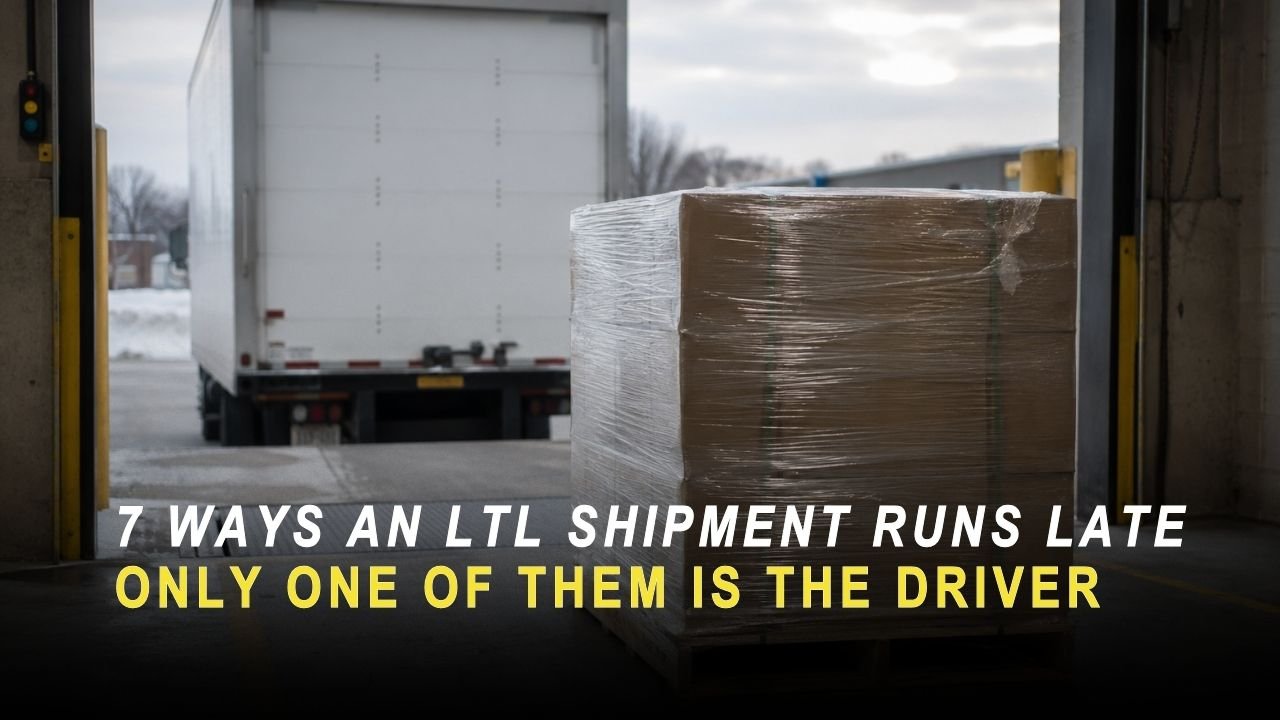
Another truck may hold the door. The receiver may be short-staffed. Security may not find the appointment. Wrong labels or purchase-order details can hold up check-in. Because an LTL route has several stops, one long wait makes every later appointment harder to meet.
Driver detention is serious enough that the U.S. Federal Motor Carrier Safety Administration keeps studying its effect on trucking operations and safety, citing research that links longer dwell times to lost driver earnings and higher crash risk. The FMCSA detention study tracks pickup, delivery and detention data to understand these delays.
How to Prevent It
Keep separate records for arrival, check-in, dock assignment, and completed delivery. One delivery timestamp will not show where the time went. You need those four to prove it later.
6. Too Many Handoffs Slowed the Shipment Down
Standard LTL freight may pass through several hands before it reaches the receiver.
A local carrier collects the pallet. An origin terminal sorts it. A linehaul carrier moves it toward Ontario. A destination terminal receives it. A local agent makes the delivery.
Every handoff adds a loading cutoff and another chance to miss a connection. It also makes problems harder to trace: the company that sold you the transport may not run the truck at the door, so a rejected shipment turns into your team calling a broker, who calls a terminal, which calls the local agent.
In my experience, freight that arrives damaged, short or misrouted has usually passed through more terminals than it needed. National networks earn their keep when freight must reach many provinces or remote postal codes. For shipments that stay in Ontario and hit the same receivers, a regional carrier gives you more control.
How to Prevent It
Ask how many companies and terminals will touch your freight before you book. Fewer hands mean fewer missed connections.
7. Weather, Road Conditions or Capacity Disrupted the Route
Some delays happen even when the shipment was booked correctly.
Freezing rain can slow a whole route. A collision on Highway 401 or the QEW can close lanes for hours. Mechanical trouble can pull a truck from service. Seasonal retail volume can fill trailers and docks faster than expected.
Ontario 511 shows current construction, collisions, closures and conditions, which helps when a time-sensitive shipment might hit severe weather or a major incident.
A carrier cannot keep a highway open. It can warn you early, update the receiver and stop promising a time it can no longer meet.
How to Prevent It
Leave recovery time. Freight released at the last minute has no room for a short delay. Check 511on.ca before a time-sensitive run on the 401 or QEW.
What Can a Missed Delivery Appointment Cost?
The carrier invoice may show a redelivery charge, but the real cost can include:
- A second delivery attempt
- Storage at the destination terminal
- Driver waiting time
- Retail compliance deductions
- Staff time spent tracing the shipment
- Lost shelf availability
- A lower vendor score
- Damage to the customer relationship
Retail deductions depend on the vendor agreement, and there is no single chargeback that applies to every retailer. Keep the appointment confirmation, tracking events, check-in time, exception notes and proof of delivery together, so you have the record if the receiver reports the shipment as late.
How to Find Where the LTL Delay Started
Review the shipment in order.
Check when the order was released, when the pallet was ready and when the driver collected it. Compare the booked pallet count, dimensions, weight and delivery requirements against what actually shipped.
Review the requested appointment, the confirmed appointment and any changes sent to dispatch. List every terminal and carrier, and check whether the freight reached the destination terminal before the local route left.
Finally, line up the driver’s arrival, the receiver check-in, the unloading time and the signed proof of delivery.
Assign the failure to the stage where it began. Logging every late shipment as “carrier late” gives you nothing to fix.
When Recurring Ontario Distribution Makes More Sense
One-off bookings work for occasional freight. They get harder to manage when the same shipments move to the same Ontario receivers every week.
A scheduled program may fit better when narrow appointment windows, repeated access instructions, multiple carriers and regular redelivery charges are eating your team’s time. Our QRC Logistics Ontario LTL and final-mile delivery service connects freight staging, transport, receiver appointments and delivery confirmation through one Ontario team.
If the same lanes keep missing windows, review the last month of shipments: release times, pallet details, appointment confirmations and delivery records. The pattern usually shows where control is being lost.
Want a faster way to run that review? Download our LTL delay diagnostic checklist and work through last month lane by lane. It follows the same checkpoints in order, so you can name the stage where each delay began.
If the pattern points to a carrier problem you cannot fix from your side, book a 15-minute call with our Halton Hills team. We will look at your Ontario lanes and show you where a scheduled program would cut the redelivery charges.