
If you run a 4PL, your client has handed you their whole supply chain.
They expect one name to call when something goes wrong. You can only keep that promise if the company doing the physical work in each country does its job well.
So when your client starts selling into Canada, you need a partner here. Someone who will unload the containers, store the stock and get it to the stores on time, without adding one more vendor for your team to chase.
TL;DR
- A 4PL (fourth party logistics provider) plans and manages a client’s whole supply chain. A 3PL (third party logistics provider) mainly does the physical work in a region: unloading, warehousing, transportation and delivery.
- Many 4PLs do not run their own warehouses or trucks. They hire a 3PL in each country to do that work, so if the 3PL delivers late or damages the stock, the 4PL’s client sees it as the 4PL’s mistake.
- To choose a 3PL partner, ask for proof in writing: an on-time rate with its time period, named escalation contacts, a recovery plan, KPI reporting, space for busy seasons, and how they protect your client relationship.
What is the difference between a 3PL and a 4PL?
A 3PL does the hands-on logistics work in the region it serves. Some 3PLs also manage other providers for their clients, as our guide to the types of 3PL providers explains.
A 4PL designs and manages the whole supply chain, and is responsible to the client for the end result.
They usually work together. DHL describes a 4PL as the provider that “coordinates all the moving parts,” and notes that a 4PL model incorporates 3PLs.
Our VP uses this example. Take a brand shipping from Ireland into Canada. Without a 4PL, the brand needs four relationships of its own: an ocean or air carrier, a customs broker, a warehouse to unload the containers, and a carrier for final-mile delivery to the stores.
A 4PL holds all four for the brand. When something goes wrong, the brand gets one answer, not four providers blaming each other.
Here is how the two compare side by side:
| Question | 3PL | 4PL |
| What does it do? | The hands-on work in one region | Plans and runs the whole supply chain |
| What services does it offer? | Container unloading, warehousing, trucking, final-mile delivery | Choosing and managing carriers, brokers and warehouses, and reporting to the brand |
| Does it own warehouses and trucks? | Often, yes | Often, few or none |
| Who is responsible for the end result? | Only its own part of the job | The whole delivery, start to finish |
| When does a brand choose it? | When the brand manages its own providers | When the brand wants one company to handle everything across countries |
Why do 4PLs work with regional 3PLs?
Owning warehouses and fleets in every market would tie up capital and take years.
A regional 3PL already has the warehouse, trucks and staff in place. So a 4PL can serve a client in Canada without building its own warehouse or fleet, and use more or less space as volumes change.
Because they don’t own warehouses, many 4PLs can choose the best provider for each step. Not every 4PL works this way. Some are tied to their own or partner warehouses.
The downside is that you depend on the 3PL’s work. Your client may never meet your 3PL in Canada. But they see every late delivery and every crushed carton.
How should a 4PL vet a regional 3PL partner?
Get these six things in writing before the first container arrives:
| Ask for | Why it matters |
| On-time delivery rate, its time period, and what counts as on time | A percentage with no period or definition tells you little |
| Named escalation contacts | You need a senior person who can make decisions |
| How they recover when a truck breaks down | Your client measures you on on-time delivery |
| Reporting on your client’s KPIs, sent by EDI or API | The numbers should arrive in your systems automatically, not in a spreadsheet you retype |
| How much warehouse space they can add in busy seasons | Your client’s volumes will not stay flat |
| How they handle your client if your client calls them | If a 3PL goes around you, you can lose the client |
Here is how we handle each of these at QRC.
Who answers when something goes wrong?
You should be able to reach people who know your account and can make decisions.
When you manage freight from another continent, a ticket number and a voicemail can cost you days.
As I said in an interview in January 2026, “we’re only as good as our last delivery.” And we make thousands of them a day.
We are large enough to deliver across Canada, with our own fleet and carrier partners. But we are still small enough that if a problem needs senior attention, I will get involved. So will our VP and our general manager.
Can the 3PL recover when a truck or route fails?
A 3PL with its own regional fleet and many routes can work around a breakdown, a storm or a moved appointment.
A carrier with one truck or one lane often cannot.
Because we run our own trucks, we can move freight to another truck or route on our own lanes when capacity and delivery windows allow.
Ask us for our on-time rate, with its time period and definition, before you sign.
Will the reporting match what your client measures?
Good 3PL reporting uses the same KPIs your client uses to judge you. Usually that means on-time delivery, order accuracy and damage.
At QRC, we agree on those KPIs with each partner at the start, based on what their own clients hold them to. We send the reports by EDI or API.
Can the 3PL handle busy seasons?
It should. Volumes jump around launches and holiday peaks, and your 3PL should absorb that without a new contract.
At QRC, your client’s space flexes inside our 300,000 sq. ft. facility. You use more in busy seasons and less in quiet ones.
For delivery, our own fleet and carrier partners mean peak volume does not depend on a few trucks.
Will the 3PL protect your client relationship?
At QRC, we work for you, not for your client. Your client deals with you, and we do the work in Canada on your behalf. As our VP puts it, we work with our partners “confidently and confidentially.”
We will not compete with you for freight we already handle for you. And if your client ever calls us directly, you will hear about it from us first.
What happens to a 4PL’s container once it reaches Canada?
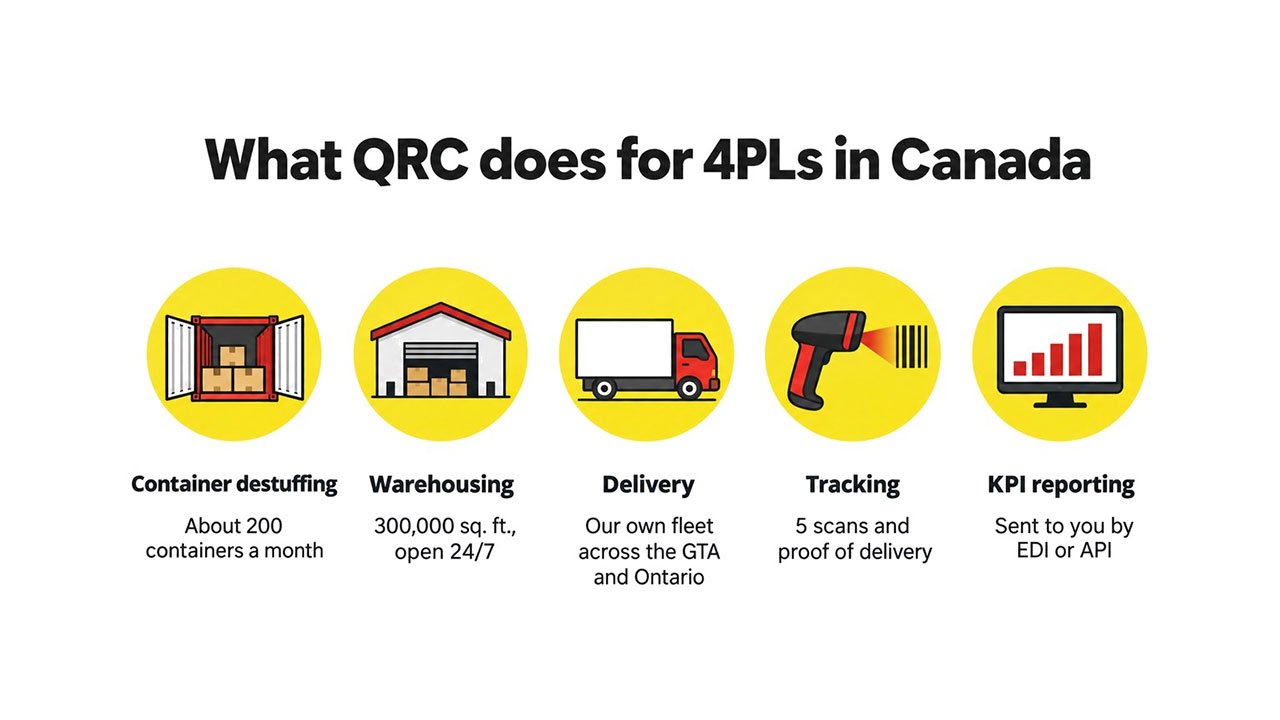
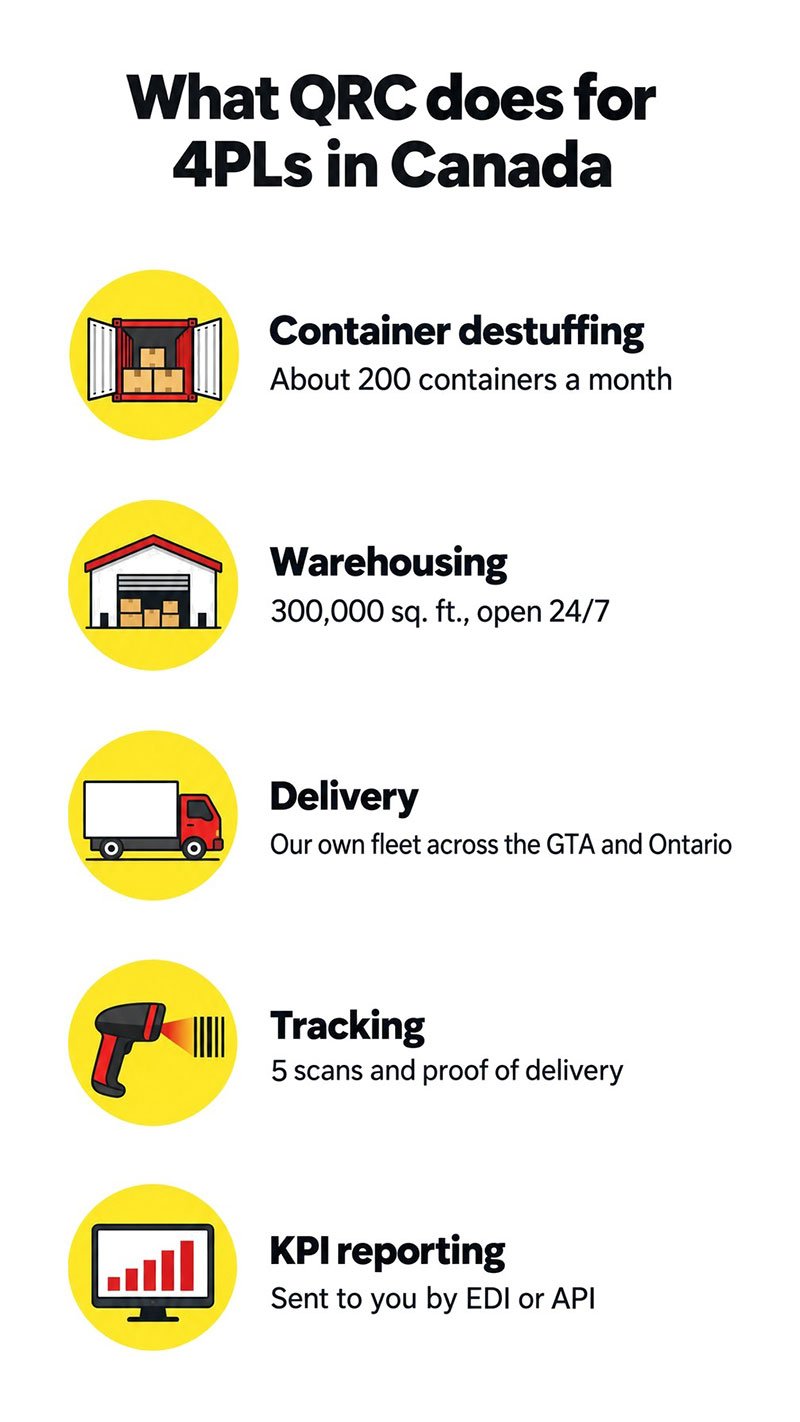
We unload it, build pallets to your client’s specification, and send the stock to storage or straight onto a delivery truck.
Where does QRC’s work start?
Containers that land on the west coast or at the Port of Montreal often travel into the Toronto area by rail. Customs clearance stays with you and your client’s broker, and your team arranges the move from the rail terminal to our dock.
Our work starts when the container arrives at our dock in Halton Hills, one block off Highway 401. We run our 300,000 sq. ft. facility 24 hours a day, seven days a week. We also receive 53-foot trailers from the United States.
How are containers unloaded and palletized?
We destuff about 200 ocean containers a month. Most arrive floor-loaded, with cartons stacked loose from floor to ceiling. Our crew unloads them by hand.
Then we build each pallet to the client’s TI-HI, so the pallets fit the store’s racking. They also stay at a safe height for store staff to unload.
Where does the stock go next?
The stock is stored in our warehouse, grouped by destination ready to load, or cross-docked for our own fleet or a carrier partner.
We have offered white-glove retail delivery since the 1990s. For some retail clients, our driver delivers overnight, using a key and alarm code, so the stock is in before staff arrive.
How is each shipment tracked?
We scan every shipment five times:
- Into our facility
- Again, to confirm it is going to the right place
- Onto the truck
- At the store
- On delivery
We confirm every delivery with proof of delivery.
Where is QRC the right fit, and what happens after you call?
We are family-operated and have been in business since 1978.
We fit best when your client’s freight arrives in the Toronto area and needs to reach stores, distribution centres or businesses in the Greater Toronto Area (GTA) or on our scheduled lanes in Southern and Eastern Ontario. That is where our own trucks run.
For the rest of Canada, we deliver through carrier partners.
If that fits, here is how we usually start:
- You tell us what your client ships, how often, and where it needs to go.
- We review the fit and walk you through our facility.
- We agree on KPIs, set up your EDI or API connection, and plan the first shipment.