
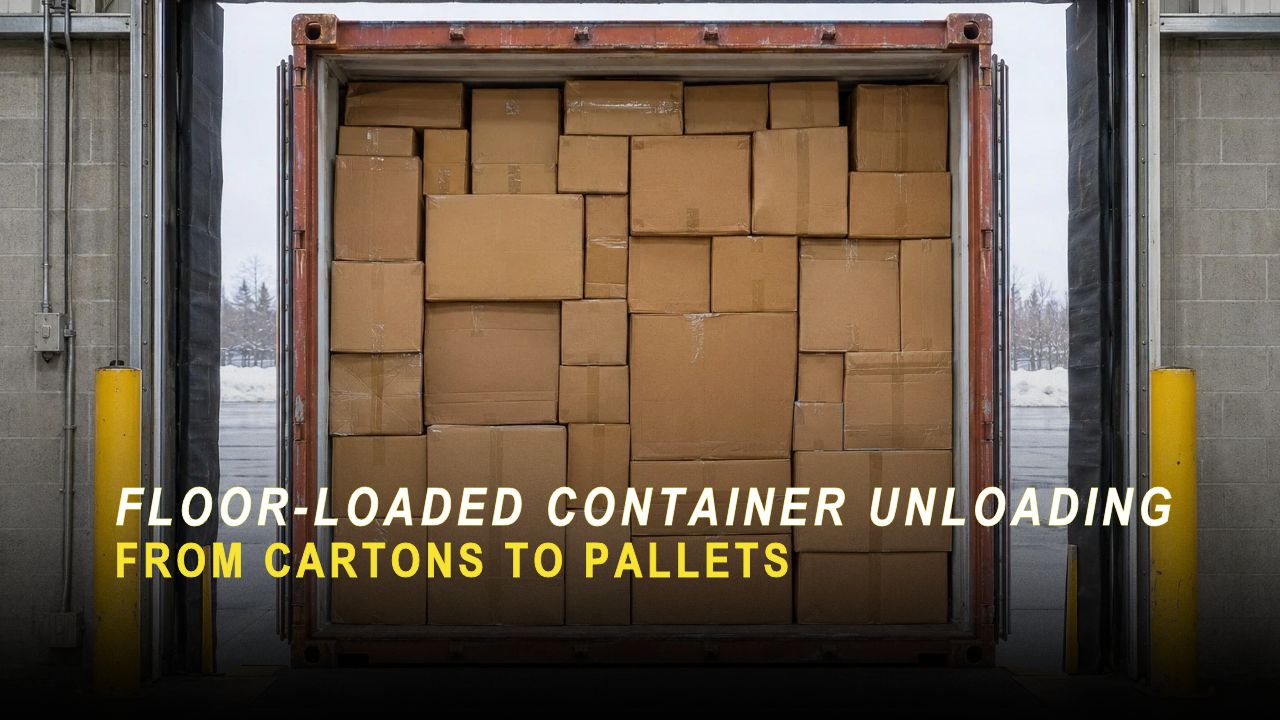
Open the doors of a floor-loaded container and you see cartons. Nothing else.
No pallets. No gaps. Just boxes stacked from the floor to the ceiling, all the way to the front wall.
Every one of them has to come out, usually by hand. Then it has to be sorted, counted and stacked on a pallet that a store will accept.
So how does that work? What does the warehouse need to know first? And what happens when the count comes up short?
TL;DR
- In a floor-loaded container, cartons sit on the container floor, not on pallets. A crew usually lifts out each carton by hand, sorts it by SKU and builds the pallets at the dock.
- The unload goes well when the dock has three things first: a packing list by SKU, a pallet specification and your instructions for where each SKU goes next.
- Shortages and damage should be recorded at the door. Once the stock is in storage, a missing carton is much harder to trace.
What Is a Floor-Loaded Container?
In a floor-loaded container, cartons are stacked directly on the container floor rather than shipped on pallets. They fill the container from the front wall to the doors and up to the ceiling.
At QRC, we unload about 200 ocean containers a month at our dock in Halton Hills. Most of them arrive this way.
It means one thing for the receiving end. The pallets the stores expect do not exist yet. They get built in Ontario, carton by carton.
Why Do Shippers Floor-Load Instead of Palletizing?
Shippers floor-load for two reasons: they fit more cartons in the container, and they send fewer wood pallets across a border.
The first reason is space. A pallet takes up height, and a pallet load leaves gaps at the walls and the ceiling. Loose cartons fill them.
The second reason is wood. Canada regulates solid wood packaging arriving from overseas, and that includes pallets. Packaging made only from plywood, cardboard or plastic is exempt. The Canadian Food Inspection Agency warns that packaging which does not comply may be refused entry.
A container with no pallets has less wood to check. It is not always wood-free, though. The same rules cover the wood blocks and braces some shippers use to hold a load in place.
Neither choice is free. Here is where the work and the cost go:
| Floor-Loaded | Palletized at Origin | |
| Cartons per container | More | Fewer |
| Wood pallets crossing the border | None, though wood bracing still counts | Yes, and solid wood pallets from overseas must meet Canada’s import rules |
| Unloading at destination | By hand, carton by carton | By forklift |
| Who builds the store pallet | The warehouse in Canada | The factory, often to a different standard |
| Destination labour cost | Higher | Lower |
Floor-loading usually wins when the freight saving on extra cartons is larger than the unloading labour. It can also save a second handling step when pallets built overseas would need to be rebuilt for Canadian retailers.
What sets the unloading price? At QRC, we quote each program on the container’s contents: how many cartons and SKUs, how heavy the cartons are, how much sorting they need, and how the pallets must be built.
What Should You Send Before the Container Arrives?
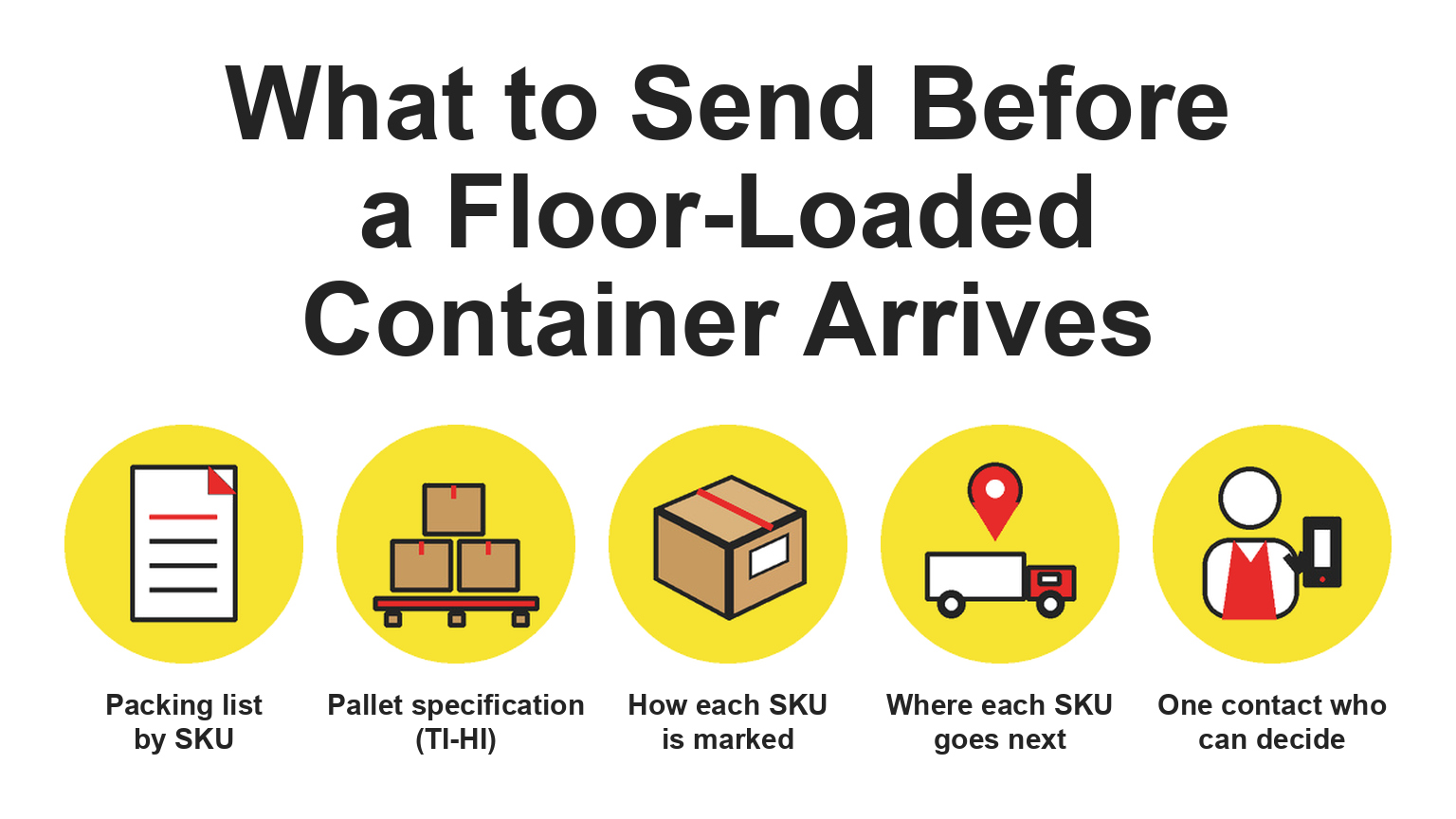
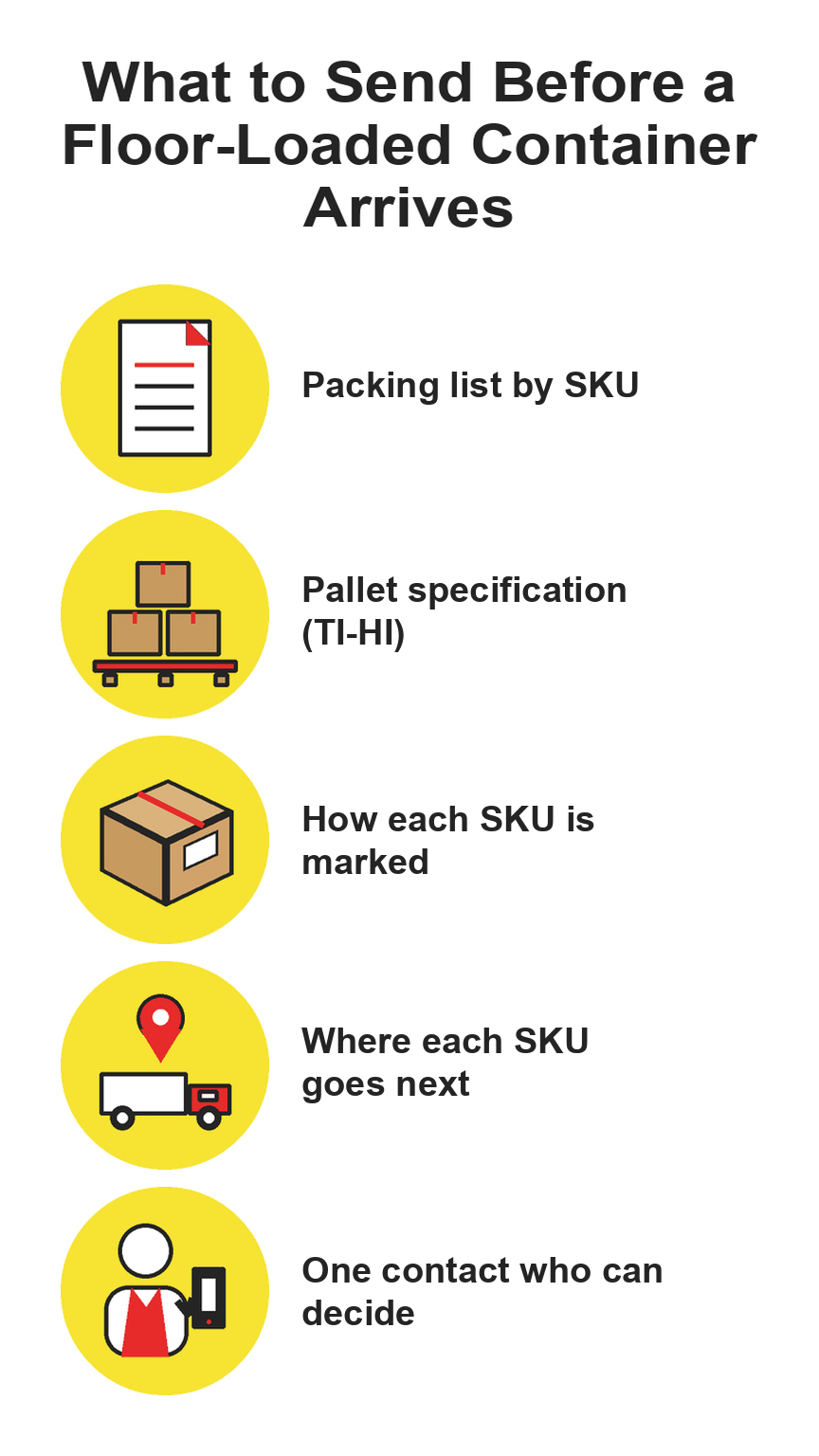
Send a packing list by SKU, a pallet specification and your instructions for each SKU. The crew makes its decisions while the cartons are coming out, so late instructions cause delays and rebuilt pallets.
| What to Send | What the Dock Does With It | What Happens Without It |
| Packing list with the carton count for each SKU | Checks the unloaded count against it | A shortage is harder to verify |
| Pallet specification for each SKU (TI-HI: cartons per layer and layers per pallet) | Builds each pallet to it as cartons come out | Pallets are built to a guess, then rebuilt |
| How each SKU is marked on the carton | Sorts cartons by what is printed on them | Similar SKUs end up on one pallet |
| Where each SKU goes next: storage, or which delivery | Groups pallets by destination | Stock is moved twice |
| One contact who can make a decision | Calls that person when something is wrong | The stock waits |
The pallet specification is the easiest one to miss, because nobody at origin needed it. Ask the retailer for it early.
How Is a Floor-Loaded Container Unloaded?
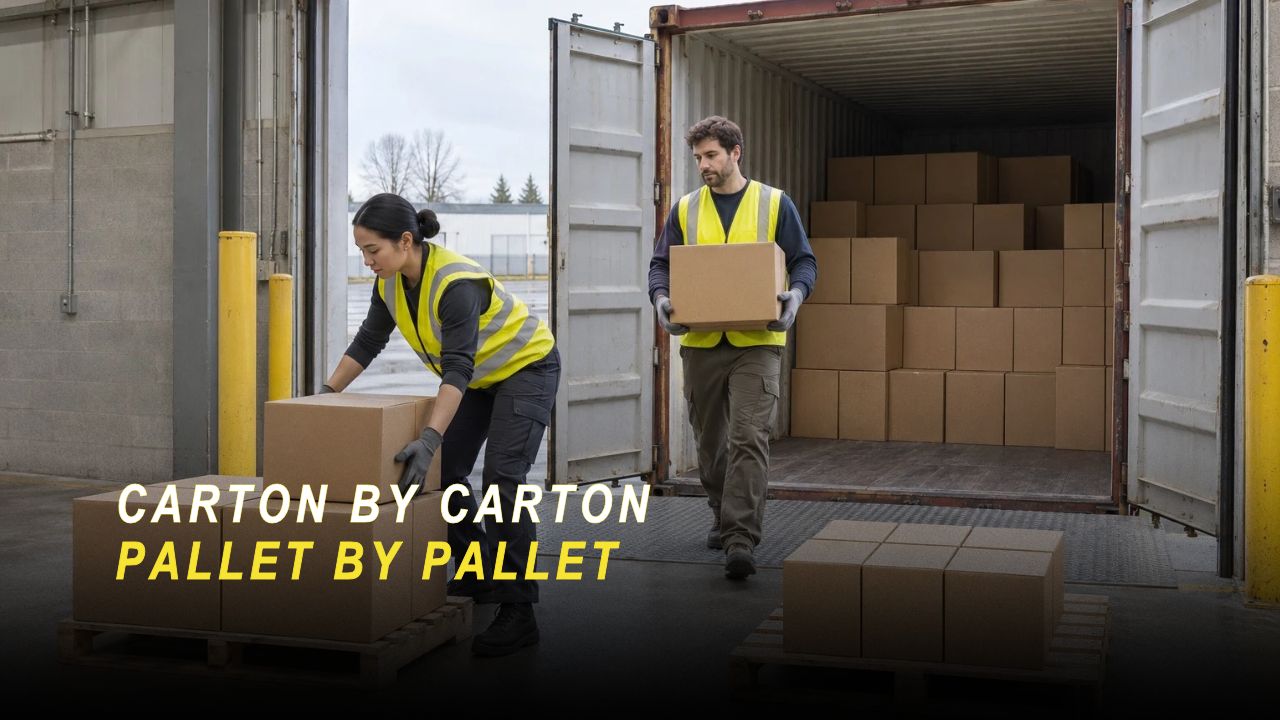
A floor-loaded container is usually unloaded by hand, a job also called container destuffing or devanning. The crew works from the doors toward the front wall, sorts each carton by SKU and stacks it on a pallet for that SKU.
Here is the usual order:
- Open the doors. Cartons shift at sea, so the first rows are taken down with care.
- Lift and sort. Each carton goes to the pallet for its SKU.
- Build the pallet. The crew follows the TI-HI for that SKU.
- Check in. The count for each SKU is compared with your packing list, and the pallets are scanned into our facility.
How long does it take? That depends on what is inside, so we confirm the timing for your container once we have seen the packing list. Four things slow an unload:
- Mixed SKUs loaded together. The crew has to sort while it lifts.
- Cartons with no clear marking. Someone has to stop and identify them.
- Heavy or odd-shaped cartons. They need two people or a different stack.
- Crushed cartons at the bottom. Each one has to be set aside and recorded.
You can reduce the first two. Ask the factory to load one SKU at a time and to print the SKU on two sides of every carton.
What Happens When the Count Does Not Match?
A shortage, an overage or a damaged carton should be recorded at the dock door, before the stock goes into storage, and reported to you with the evidence.
Timing matters here. At the door, the container is still at the dock and the cartons are still together. A week later, the stock is in racking and some of it has shipped. Was the carton short at the factory, lost on the way or miscounted in Ontario? That is now much harder to work out.
So agree on the exception report before the first container, not after the first shortage. Whichever warehouse you use, ours included, get these five points in writing:
- What is recorded: the count for each SKU against the packing list, every damaged carton, and photos.
- Who receives it: one named person on your team.
- When it is sent: before the stock is released for delivery.
- What happens to damaged cartons: held in a separate space until you decide, never sent to a store.
- When stock becomes available: the point at which counted stock can be ordered, and who approves it.
Want to test a warehouse further? Our guide to inventory accuracy in a 3PL warehouse lists the receiving controls to look for, starting with scanning instead of typing counts by hand.
Then whoever owns the stock hears about a problem from you first, with the photos to explain it.
[Gloved hands photograph a crushed carton set apart on its own pallet at a receiving dock]
What Do You Get Back After the Unload?
You get the stock on pallets built to the retailer’s specification, counted and scanned in, with a record of anything that did not match.
You can also see it. We give partners access to our warehouse management system from the first day, so you can check stock and movements yourself without calling us.
At QRC, the same team handles container unloading, palletizing, storage and delivery. Once the cartons are counted and palletized, the stock can follow one of three routes. It is stored in our warehouse, held on the dock floor in groups by destination until its truck is loaded, or moved straight across the dock to a delivery truck.
If you are still choosing a Canadian partner, our guide to 3PL vs 4PL covers what to ask before you sign.
Send the Paperwork Before the Container
When the paperwork is right, you know exactly what arrived, what was damaged and what is ready for delivery.
Do you have a floor-loaded container coming into Ontario? Book a call and have five things ready: the container size, the arrival date, the carton count, the SKU list and where the stock goes next. We will tell you what our dock needs from you.