
You move freight from Michigan into Ontario, and you just heard the border got faster. It did.
But if your shipments have been landing late, the border was probably not the reason. I have seen loads clear the crossing on time and still miss the receiver’s dock by a day. The real Gordie Howe Bridge freight impact is smaller than the headlines make it sound.
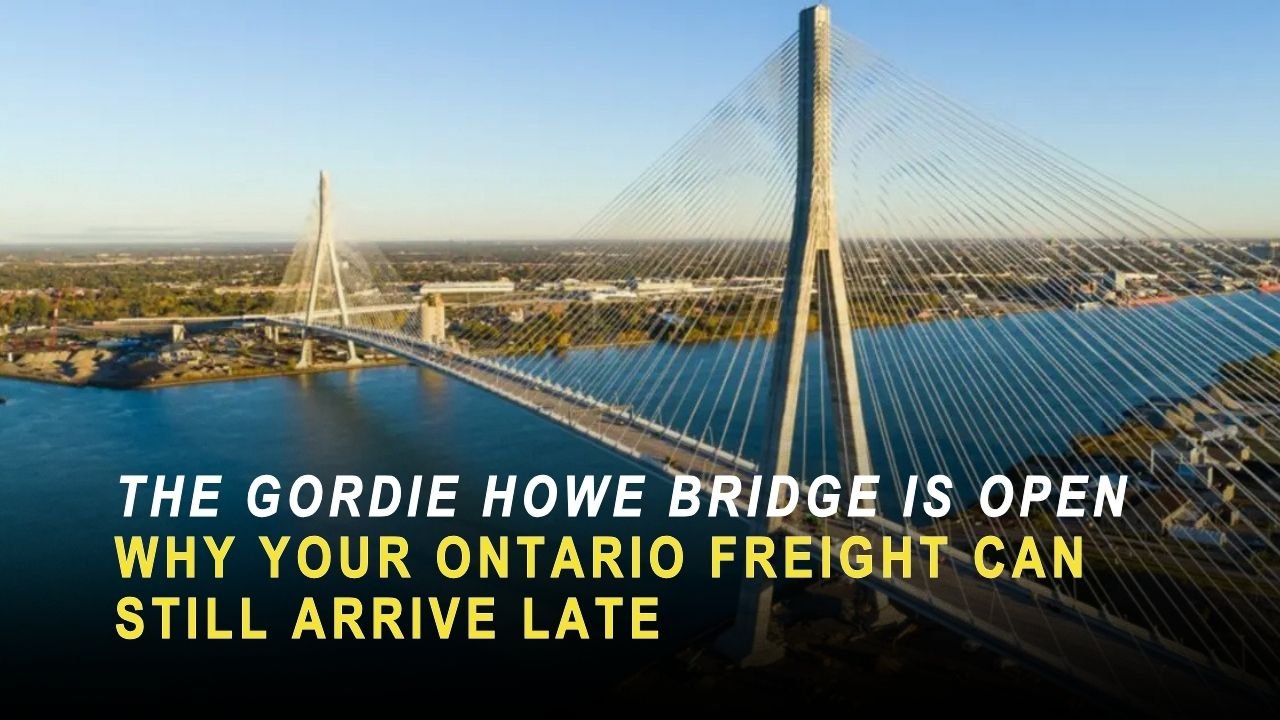
The new bridge opened to trucks on July 27, 2026, and the early word from drivers is good. Here is what that speed does for you, what it does not, and how to tell when the Ontario leg of your freight needs its own carrier.
TL;DR
- The bridge reduces border friction through a direct Highway 401 to I-75 connection, a stoplight-free approach and inspection technology that avoids unloading many trailers.
- It does nothing for customs paperwork, carrier handoffs, cross-dock dwell, receiving appointments, or final-mile capacity.
- In the illustrative two-skid example below, the crossing accounts for under an hour of a two-to-three-day move.
- If your Ontario receiver is appointment-only or needs lift-gate or inside delivery, that is where the delivery date is won or lost.
| Segment | What happens | Did the bridge change this? | Who controls it |
| Pickup and dock-out | Freight is loaded at the US shipper | No | US shipper |
| Line-haul to the border | Truck runs to the crossing | No | US carrier |
| Border approach, crossing and inspection infrastructure | Direct highway connection and modern screening | Yes | Carrier and border agencies |
| Customs documents and release | Entry information is reviewed and cleared | No | Shipper, importer, broker and CBSA |
| Carrier handoff or cross-dock | Load transfers to an Ontario carrier | No | Whoever books the Ontario leg |
| Ontario line-haul | Run to the destination region | No | Ontario carrier |
| Receiver appointment and dock wait | Waiting for the receiving window | No | Receiver |
| Final-mile delivery | Last stop, often with special handling | No | Final-mile carrier |
One row changed. That is the whole story.
The bridge authority points to the direct highway connection and modern ports of entry as the main improvements. Its own toll FAQ adds that time savings depend on your origin, destination and time of day.
What the Gordie Howe Bridge Freight Impact Actually Covers
Start with what got better, because it is real and it matters for your planning.
A Direct Highway-to-Highway Connection. The bridge links Highway 401 to I-75 through the Herb Gray Parkway, with no traffic lights between the freeway and the border. If you have run the old Ambassador Bridge route, this is the big one. That approach sent trucks onto Huron Church Street and its long line of stoplights first. The carrier that made the first commercial crossing told the Detroit News the new route cuts about seven stoplights on the Canadian side.
More Capacity and Faster Inspections. The crossing has six traffic lanes and sixteen toll lanes, with 60 inspection lanes across the Canadian and US plazas. According to Truck News, many inspections that once meant unloading a trailer now run through X-ray imaging. Farm and meat checks happen inside the complex instead of off-site. Fewer offloads means fewer of the multi-hour holds that used to wreck a schedule.
A Large Time Saving, with a Caveat. Federal officials estimate the bridge will save carriers about 850,000 hours a year across the corridor. Read that for what it is. It is a border saving, spread across a huge number of trucks on a route that carries about a quarter of all Canada-US truck trade. It says nothing about your shipment’s total transit time.
One honest note. Truckers who crossed first told CBC the run is smoother but does not lower prices. Faster at the border does not mean cheaper. It does not mean on time either.
The Delays the Bridge Was Never Going to Fix
Think about your last late shipment. The border was probably not the problem. Many of the Ontario freight delays we see start after the crossing.
Customs Documents That Are Not Ready. A fast crossing still stops cold at a paperwork mismatch. If the release is not in order when the truck arrives, it waits. No bridge changes that. Getting the documents right before the freight moves can save more time than the faster crossing adds.
Carrier Handoffs. Many cross-border LTL shipments transfer to a Canadian carrier before they reach the final Ontario stop. Every handoff adds a queue. The freight gets received, sorted, and rebuilt onto a new trailer before it moves again.
Cross-Dock Dwell. Freight can sit at a border-area dock, waiting to be built into an Ontario line-haul with room for it. Dwell at the wrong dock, far from the destination, is pure delay. Cross-dock closer to where the freight is going and that wait shrinks.
Receiving Appointments and Hours. This is the one that catches shippers most. Ontario grocery, big-box, and third-party distribution centres run appointment-only receiving with tight windows. Miss the window by twenty minutes and you do not go next. You rebook for the next open slot, which can be a day or two out. The truck can be early to the region and still late to the dock.
Final-Mile Capacity. Lift-gate, inside delivery, and two-person drops into the GTA and southwestern Ontario need the right equipment and an available driver. The border does nothing for that. If the last stop needs special handling, the last leg is where your date lives or dies.
These delays remain outside the bridge’s control, and most continue after the truck enters Ontario.
Border Time Versus Dock-to-Door Time
The border is a small part of the clock. The timeline below is an example, not measured data, but it shows the usual shape of a cross-border LTL move.
Example Timeline for a Two-Skid LTL Shipment from Metro Detroit to Halton Region
| Stage | Typical time |
| Pickup and dock-out, metro Detroit | Same day |
| Line-haul to the Windsor-Detroit crossing | 1 to 3 hours |
| Border crossing and customs, clean paperwork | Under 1 hour |
| Cross-dock and handoff to an Ontario carrier | Several hours to overnight |
| Ontario line-haul to the Halton Region | Half a day |
| Wait for the receiver’s appointment window | Same day to 2 days |
| Final-mile delivery with lift-gate or inside service | 1 to 2 hours |
On a move like this, the crossing runs under an hour. The full trip takes two to three days.
The Gordie Howe Bridge freight impact is real, but it lands on that one short segment. The rest of the time sits in the Ontario leg. That is where we often see shipments lose time.
When You Need an Ontario LTL and Final-Mile Partner
You do not need a dedicated Ontario carrier for every load. You need one when the destination is harder than the crossing. Here is the checklist I use.
Your Receiver Is Appointment-Only or Has Restricted Hours. You want someone who books and protects the window, not someone hoping to beat the dock closing.
Your Freight Needs Special Handling at the Door. Lift-gate, inside delivery, or a two-person unload all need the right truck. Check that the carrier runs that equipment before you tender the load.
You Are Moving LTL or Per-Skid Volumes. A few skids is a different job than a full trailer. Consolidation and cross-docking decide your cost and your timing.
Your US Carrier Stops at the Border. If your US carrier drops at a border dock and you arrange the Ontario run yourself, that run is the part to get right.
Your Destination Is Deep into Ontario. The further past the Windsor-Detroit crossing you go, into the GTA or southwestern Ontario, the more the Ontario leg outweighs the border.
There is a real tradeoff to weigh. Running the Ontario leg through several parties can work, but it spreads accountability across companies that each hold one piece of the move.
Judge your options on what you can measure. Who owns the receiving appointment? Do you keep shipment visibility after the border? How clean is the chain of custody through each handoff? How fast can you reach a person when a delivery slips? Decide how much of that your freight needs, then hire to match.
How We Handle the Ontario Leg
We run the part of the trip the bridge does not touch.
We are an asset-based direct Ontario carrier, and we have moved Ontario freight since 1978. We run our own core Ontario lanes. For you that means one team owns the receiving appointment, keeps shipment visibility through the handoff, holds the chain of custody, and gives you one person to call when a delivery has to change.

Our setup is built for the handoff and Ontario final-mile delivery. We run a 300,000 square foot warehouse in Halton Hills, which puts cross-dock and consolidation close to your Ontario destinations instead of back at the border. We are a member of the CBSA Partners in Protection program and the Canadian International Freight Forwarders Association.
That is the job QRC Logistics is built for. We take the freight after the border, cross-dock and stage it, then run the scheduled delivery with proof of delivery while your carrier heads back south.
Get an Ontario LTL and Final-Mile Quote
If your Ontario receiver has appointment windows or needs special handling at the door, that leg deserves a dedicated carrier, bridge or no bridge.
Send QRC Logistics your pickup location, Ontario destination, skid count, delivery window and special-handling requirements. I will quote the Ontario portion of your next cross-border shipment.