Growing brands hit this decision at a specific moment.
Orders are climbing. SKUs are multiplying. New channels keep getting added. And the warehouse setup that worked six months ago is starting to creak under the weight.
So you start asking the question.
Should we lease another building and run this ourselves? Or should we hand it to a 3PL and stop being a logistics company that happens to sell products?
The answer is not ideology. It is operational fit across cost, control, speed, compliance, and management bandwidth. Get those right and the model picks itself.
Quick Verdict
- Best for control: In-house warehousing
- Best for scalability: 3PL warehousing
- Best for peak season: 3PL warehousing
- Best for complex packaging or QA: In-house or hybrid
- Best for retail compliance: A retail-capable 3PL
- Best for growing brands: 3PL, when fulfillment is slowing down growth
Who This Comparison Is For
This is for ecommerce and retail operators hitting a fulfillment ceiling.
You are adding SKUs. Adding regions. Maybe a wholesale account. Maybe a marketplace channel. The volume is real and the pressure is daily.
Your real question is whether your team can support multichannel fulfillment without breaking the KPIs that matter most: accuracy, speed, and retailer compliance. If those start slipping, growth stops being good news.
What Each Model Actually Means
In-house warehousing means you control everything inside a facility you lease or own. That covers receiving, putaway, storage, pick and pack, labour, systems, and shipping, plus all the in-house logistics that surround it: inbound receiving, dispatch, dock work. All of it is yours.
A 3PL, or third-party logistics provider, packages those same functions into one contract, often with returns management, kitting, retail routing, and final mile delivery included as part of the service.
That is the part most cost comparisons miss. Storage fees alone do not tell you how customer orders move, how retail orders get routed, or how the brand experience holds up after the dock. A 3PL is a service operation, not a warehouse with a portal.
A hybrid model works for many brands. Keep specialized kitting or premium presentation in-house. Use a 3PL for overflow, regional distribution, or peak capacity. We will get to that further down.
Cost Structure: Fixed Costs vs Variable Costs
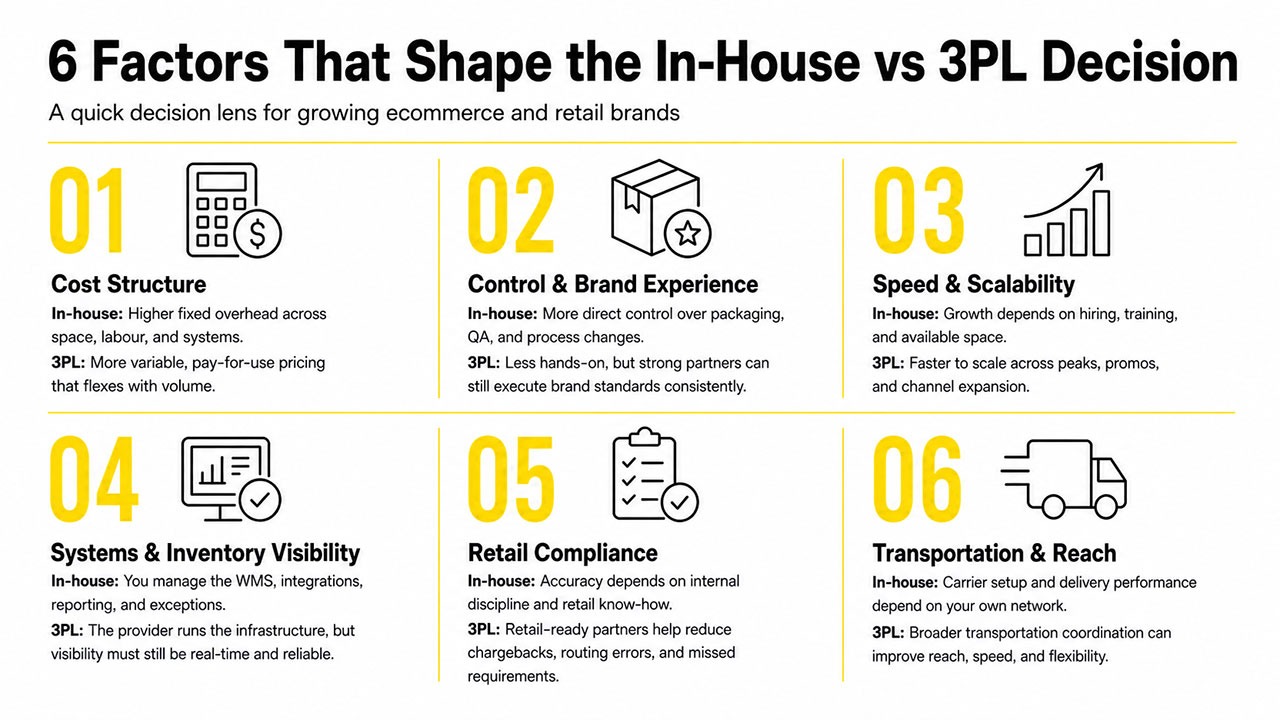
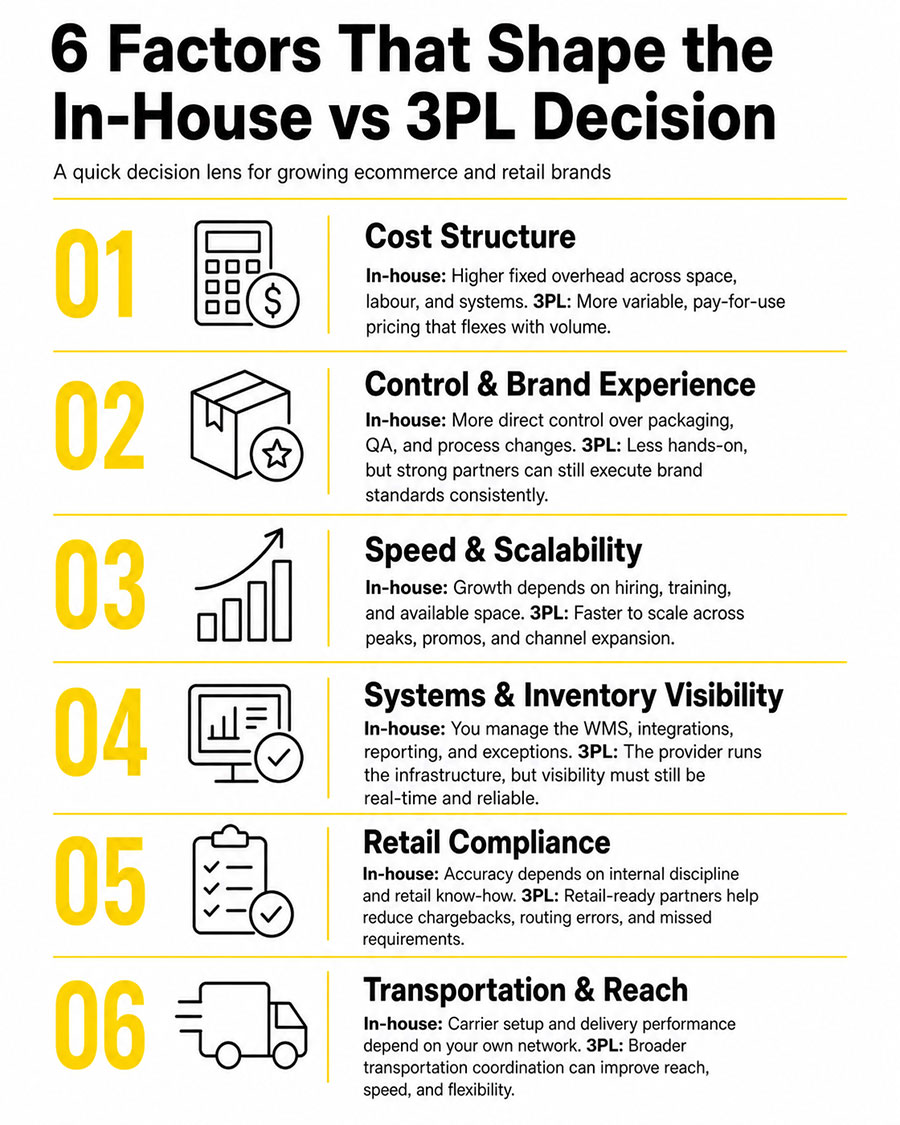
Start with the principle: in-house is a fixed-cost stack, and a 3PL is a variable-cost stack. The full cost of in-house warehousing extends well past rent.
The full stack includes racking, forklifts, warehouse management systems, insurance, utilities, maintenance, shrink, safety programs, and supervisory overhead. All of it sits on the same bill, every month, whether you ship 500 orders or 5,000.
The trickier costs are the ones you do not see at first. Pick and pack errors, parcel shipping problems, and labour inefficiencies tend to hide inside other budget lines. By the time you spot them, they are already eroding margins.
A 3PL flips the model. Receiving, storage fees, pick fees, packaging, and value-added services become the bill, which means outsourced warehousing and fulfillment cost only what you use. Minimums and accessorials can change the math, so read the fine print before you sign. But you stop paying for idle space and idle people during slow months, and that is the real advantage. Not always cheaper. Often less risky.
How to Compare the Two Honestly
Hourly wages will lie to you. Forget them.
Compare the two models on cost per order, cost per unit shipped, and fully loaded cost per pallet position. And factor in shipping costs too, because where your warehouse is and how it operates affects which carriers you can use and how efficiently freight moves out the door.
Then build a separate forecast for peak months. Promotions and Q4 volume distort the annual average. If your model ignores overtime, temp labour, or overflow space, in-house will look cheaper than it actually is.
Canadian Realities That Skew the Math
Southern Ontario is its own beast.
Industrial real estate is tight. The labour market is competitive. Equipment and software costs often get financed alongside the warehouse lease, which pushes break-even further out than founders expect.
Cross-border distribution adds another layer. Duties, regional carrier coverage, and customs delays all change landed cost and delivery speed. None of it shows up in a per-square-foot rate comparison.
Control and Brand Experience
In-house teams genuinely can win on control.
Packaging presentation, rapid SOP changes, and hands-on quality control all work in your favour when the operation is still manageable. The COO walks the floor and fixes things in real time. The team knows every product by SKU.
It stops working the day leadership starts running on informal habits instead of documented standard operating procedures. Volume exposes every weak process across receiving, replenishment, and shipping. The cracks show fast.
Control is only valuable when it is measurable, repeatable, and properly staffed.
A mature 3PL with documented SOPs, performance reporting, and exception management can outperform an internal team running on instinct. Not because the people are better. Because discipline scales and improvisation does not.
What Real Quality Control Looks Like
Real quality control is measurable.
That means tracking pick accuracy, cycle counting cadence, shrink rate, and returns management turnaround. Reviewed monthly, with numbers everyone can see.
Whether you run in-house or outsourced, three things separate real quality control from good intentions:
- Service level agreements (SLAs) that put a number on expected performance, like 99.5 percent pick accuracy or same-day shipping by 2pm, so everyone knows the bar
- Root-cause reviews that figure out why a missed shipment or wrong-product complaint happened, then fix the process so it does not happen again next week
- Exception management that catches problems before they reach the customer, whether that is a damaged item, a stockout during picking, or a retailer compliance flag
Without those, you are guessing.
Speed and Scalability
The DIY ceiling shows up when warehouse staffing, training time, and floor space stop keeping pace with demand.
In a tight labour market, adding people is slower than adding orders. Training a picker to retail-spec compliance takes weeks. You do not have weeks. You have a Monday morning meeting where the COO asks why on-time shipping dropped six points.
Many brands find out the hard way that growth can increase revenue while quietly damaging service performance.
A capable 3PL adds labour, shifts, storage, and shipping lanes faster than any internal team can build them.
That is a real advantage for retail, ecommerce, and cross-border distribution programs that need Canadian market coverage, especially when DTC, wholesale, and marketplace orders all hit the same inventory pool.
Peak Season and Promo Spikes
If you run in-house, peak season planning starts in August. That means pre-hiring, temp labour planning, overtime controls, dock scheduling, and forecasts shared with carriers well in advance.
A 3PL absorbs peak spikes more effectively. But only if you reserve the capacity early.
Show up on November 1st asking for extra space and labour, and you will not get either. Forecast in advance and the model holds up.
Technology and Inventory Visibility
Running in-house means choosing and maintaining a warehouse management system, scanners, label workflows, and reporting logic that support real inventory management.
The actual implementation eats more time than most brands expect. System configuration, user training, exception handling, and carton labeling rules all take real hours, and none of that is on the sales deck for the WMS you bought.
A 3PL usually brings established WMS workflows. The real test is integration quality and reporting transparency.
Ask one question: can I see my inventory in real time, audit it by lot or batch, and trace it across channels? If the answer is no, the software stack is not actually supporting your growth. It is just sitting there.
Integration Checklist Before You Launch
For ecommerce, confirm integrations with Shopify, Amazon, marketplaces, your shipping software, and returns portals. Test them. Do not take “yes, we integrate” as proof.
For retail, validate routing guide compliance, ASN generation, EDI workflows, appointment scheduling, and retailer-specific label formats. Those details matter more than the dashboard demo.
Retail Compliance and Chargebacks
Retail compliance is where growing brands lose margin quietly. Incorrect labelling, late ASNs, packaging errors, and missed delivery windows each trigger a chargeback, and each chargeback chips away at the margin you already booked.
Most brands do not feel it until they look at twelve months of deductions in one report. Then it stings.
As your retailer count grows, retail compliance becomes a specialized operating discipline rather than a side task for a warehouse supervisor who is already busy.
A retail-capable 3PL reduces that risk in ways that do not show up in a storage rate comparison. Retailer playbooks, pre-ship checks, and documentation standards are the kind of unglamorous work that protects margin month after month.
What to Validate With Any Warehouse Partner
Ask for documented SOPs. Ask for retailer-specific workflows. Ask for pre-ship compliance checks tied to actual execution.
If your brand ships to Canadian retailers or moves freight cross-border, validate that experience specifically. Requirements vary enough between markets to create expensive errors.
Transportation, LTL, and Final Mile
Warehousing decisions shape transportation performance more than most brands realize. Dock scheduling, carrier handoffs, and cutoff times all determine whether inventory actually moves on plan.
Brands that separate storage from transportation often miss how everything is connected. LTL, parcel shipping, and final mile delivery all depend on warehouse coordination. A 30-minute delay on the dock becomes a missed appointment at the retailer.
LTL works for palletized freight. Parcel fits smaller DTC orders. Final mile matters when delivery timing or site conditions are restrictive.
An integrated 3PL with strong coordination across warehouse, dispatch, and drivers creates real value beyond storage, with less handoff friction, fewer exceptions, and cleaner execution.
Why Facility Location Matters
A strategically placed facility near major highways and airports shortens linehaul time and improves shipping flexibility.
One well-located hub simplifies inbound consolidation and outbound Ontario distribution. That is why Southern Ontario geography matters so much for Canadian coverage. A facility off Highway 401, minutes from Toronto Pearson Airport, can reach most of the GTA before lunch.
A poorly located one cannot. And that costs you on every shipment, every day.
Side-by-Side Comparison: In-House vs 3PL Warehousing
| Factor | In-House Warehousing | 3PL Warehousing |
| Upfront cost | High due to lease, equipment, systems, and setup | No lease, equipment, or system to buy |
| Ongoing cost predictability | Stable when the space stays full, expensive when it does not | Variable, but predictable based on order volume |
| Speed to launch | Slower due to setup and hiring | Faster with existing infrastructure |
| Scalability | Limited by space and labour | More flexible across peaks and channel growth |
| Control | Highest direct control | Shared control, managed through SLAs and reporting |
| Compliance capability | Depends on internal expertise | Stronger if the 3PL specializes in retail |
| Tech burden | Brand owns implementation and maintenance | Provider runs the WMS, integrations, and reporting |
| Risk | Single point of failure if your warehouse manager leaves | Lower if you pick the right provider, higher if you do not |
| Management attention | High day-to-day burden | Lower day-to-day burden |
| Multi-channel readiness | Harder to build from scratch | Often stronger for DTC, retail, and B2B |
How to Use the Table
The table is most useful when you turn it into a quick scoring exercise.
Look at each row and rate how important that factor is to your business right now, on a scale of 1 to 5. A 1 means it does not really matter at this stage. A 5 means it is one of the biggest bottlenecks holding you back.
For example, if you are bleeding cash on an underused warehouse, give “Ongoing cost predictability” a 5. If retailer chargebacks are eating margin, “Compliance capability” gets a 5. If your team is fine and growth is steady, those rows might be a 2 or 3.
Then look at where your high scores cluster. If they line up with the column where 3PL has the stronger profile, that is your signal. Same in the other direction. If your 4s and 5s mostly favour in-house, that points the other way.
A table can clarify tradeoffs. It cannot replace an honest operating review, but it can tell you where to focus your due diligence first.
Decision Guide: When to Choose Each Model
The choice between in-house fulfillment vs 3PL is rarely about preference. It is about which model removes your biggest constraint without creating a new one. Warehouse outsourcing is the right answer for some brands and the wrong answer for others. The difference is in the operating realities, not the marketing pitch.
Choose in-house when volumes are predictable, customization is extreme, and your team can justify fixed costs with experienced operations leadership.
Choose a 3PL when growth is faster than your internal capacity, channel complexity is rising, or compliance risk is starting to erode margin.
Choose a hybrid model when brand-controlled QA, custom assembly, or premium packaging needs to stay close to the product, while storage and shipping move to a partner.
Hybrid only works when roles are clearly divided, inventory is synchronized, and exception ownership is unambiguous. If two parties think the other one owns a problem, the problem stays unowned. That is how money quietly leaks.
Questions to Ask Before You Sign Anything
Define your required service levels first, including same-day shipping cutoffs, next-day delivery zones, and retailer appointment windows. Get those locked down before you discuss price.
Then pressure-test your 12-month forecast by channel and volatility level. Bad assumptions create expensive contracts in either direction, whether you sign a lease or a 3PL agreement.
Not sure whether your current warehouse model is still working? QRC Logistics can review your fulfillment, retail compliance, storage, and transportation needs across Southern Ontario and recommend the right next step.
Choosing a 3PL Warehouse in Southern Ontario
Pick a Southern Ontario 3PL with strong access to the GTA, Highway 401, Toronto Pearson Airport, and major retail and ecommerce lanes.
Location is not a map detail. It directly shapes cutoff times, carrier options, and inventory accuracy through faster, cleaner handoffs.
And look for full-service support across warehousing, fulfillment, distribution, transportation, and final mile delivery rather than storage alone. Brands that need one partner to support growth should prioritize operational breadth, because disconnected vendors create more delay, more exceptions, and less accountability.
Not Every 3PL Is the Right Fit
If you decide a 3PL is the right direction, the next step is choosing the right type of partner.
Some 3PLs are built mainly for ecommerce fulfillment. Others operate as a retail distribution 3PL focused on big-box rollouts, EDI, and routing guide compliance. Others are transportation-led, with strength in LTL, final mile delivery, or cross-border logistics.
That distinction matters. A provider that handles parcel orders well may not be equipped for retailer routing guides, ASNs, appointment scheduling, or compliance checks. A transportation-led provider may not have the warehouse systems or inventory visibility a growing ecommerce brand needs.
The real comparison is not in-house warehousing versus any 3PL. It is in-house warehousing versus the right 3PL for your operating model.
Where QRC Logistics Fits for Growing Brands
QRC Logistics is built as a Canadian 3PL for ecommerce and retail brands that need order fulfillment, retail compliance, LTL, and final mile execution from one coordinated operation. Brands looking for an ecommerce fulfillment partner with the discipline to handle retail at the same time fit our model best.
We are based in Halton Hills, just off Highway 401 and minutes from Toronto Pearson Airport. The location matters because faster handoffs mean faster regional and national distribution. Less time on the dock, more time on the road.
Our carrier network, scalable warehousing infrastructure, and 300,000 sq ft of secure storage make us a practical fit for growth-stage brands. QRC Logistics also brings over 40 years of logistics experience, which matters because reliability in Canadian distribution is built through process maturity rather than marketing claims.
This model fits retail rollouts, ecommerce expansion, reverse logistics programs, and cross-border initiatives that need Canadian market coverage and local execution.
Space and rates are easy to compare. Coordinated warehouse operations, compliance discipline, and transportation execution are harder to judge until volume, deadlines, and exceptions start hitting at the same time.
What to Look for If Retail Is in Your Growth Plan
Prioritize proven retailer compliance workflows, documentation standards, and proactive chargeback prevention. Generic warehouse promises will not protect you when a retailer pushes through a deduction.
Tight coordination between warehouse operations and transportation is essential when deliveries are appointment-based and retailer penalties are real.
The better model is the one that removes your current bottleneck without creating a larger one six months later.
For many growing Canadian brands, that points toward a 3PL partner with compliance discipline, transportation coordination, and enough infrastructure to scale cleanly.
Explore QRC Logistics warehousing, fulfillment, and distribution services in Southern Ontario.