
Most brands know their warehouse lease cost.
Far fewer know their real warehouse cost.
The real number includes rent, TMI, utilities, labour, overtime, equipment, software, compliance errors, inventory issues, and management time. All of it sits inside the warehouse line, but most of it is buried in other parts of the budget.
This guide breaks down the main cost categories so you can see what your warehouse is really costing your business. By the end, you will have a clear picture of every line that belongs in the warehouse total, plus a sample calculation that shows how quickly the number adds up.
TL;DR
- Your rent is only a fraction of what your warehouse really costs.
- Labour, equipment, technology, compliance, and your leadership team’s time are usually where the bigger number lives.
- If you have only ever measured the lease line, your real warehouse cost is probably closer to seven figures than you think.
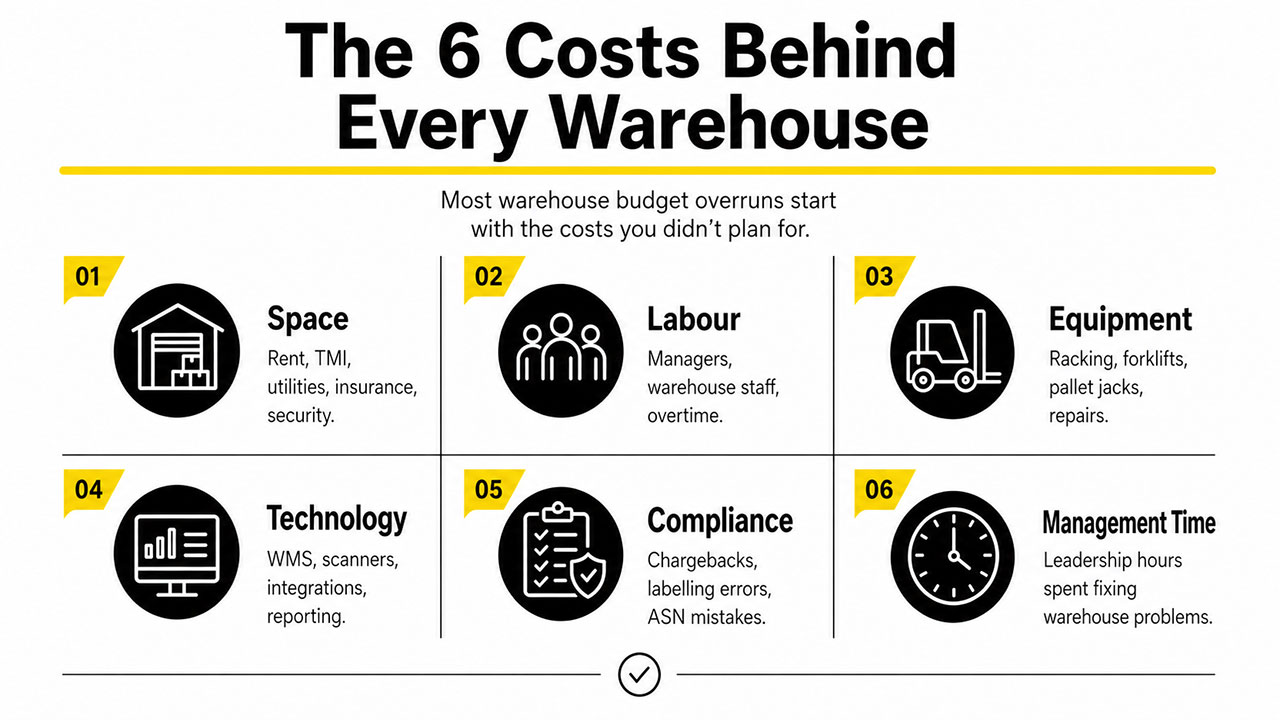
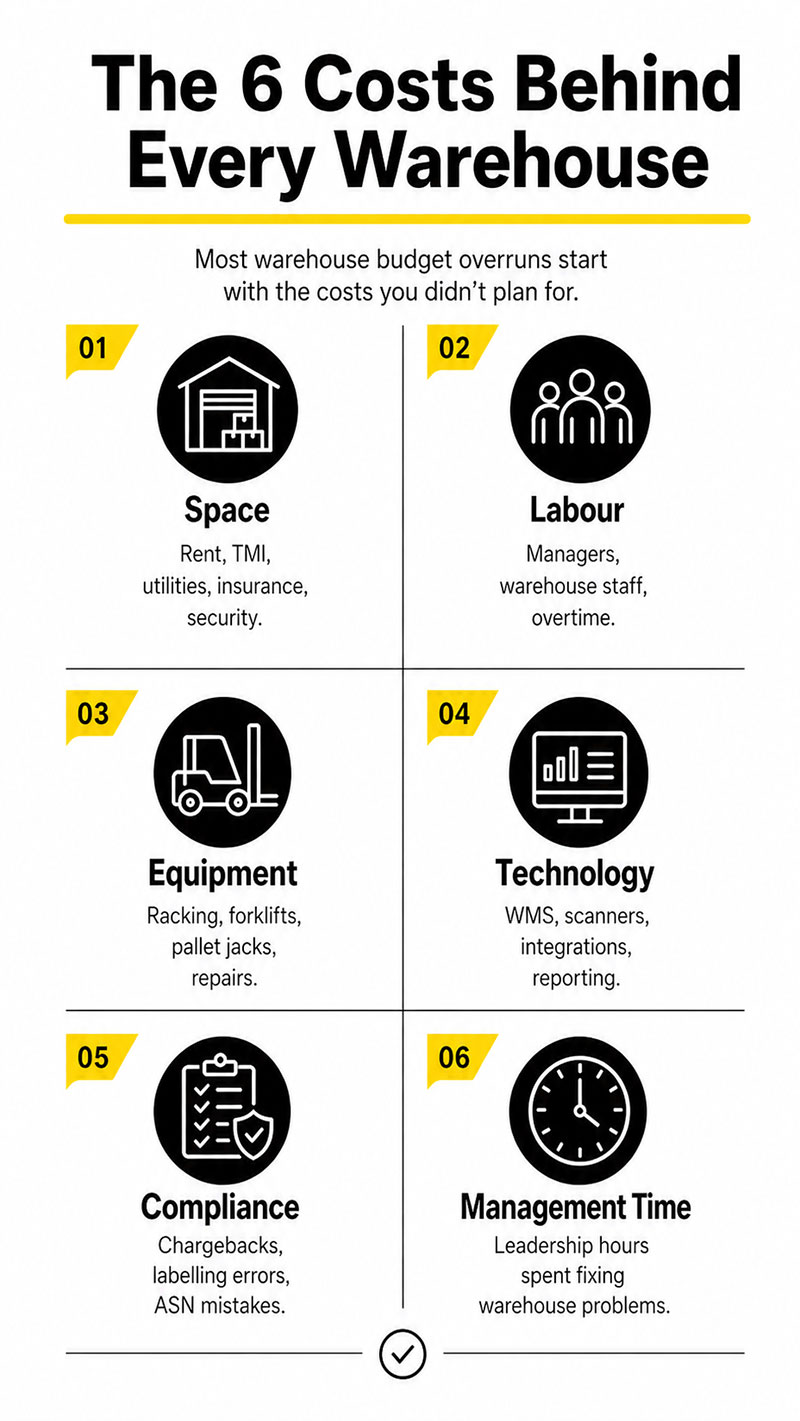
The Six Costs Behind Every Warehouse
Before pulling any numbers, it helps to know what categories you are looking for. Most warehouse cost overruns happen because one or two of these lines never made it into the spreadsheet.
| Cost category | What to include |
| Space | Rent, TMI, utilities, insurance, security |
| Labour | Managers, warehouse staff, overtime, payroll burden |
| Equipment | Racking, forklifts, pallet jacks, repairs |
| Technology | WMS, scanners, integrations, reporting |
| Compliance | Retail chargebacks, labelling errors, ASN mistakes |
| Management time | Leadership hours spent fixing warehouse problems |
Six categories. Most internal cost reviews focus on the first one and underweight the other five.
Let’s run through them.
Space Costs
This is the easiest category to pull. Accounting can usually produce it in an afternoon.
For a 20,000 sq ft warehouse in the Greater Toronto Area, current industrial lease rates run CAD 15 to 18 per square foot, net, plus TMI on top. Using recent GTA West benchmarks, a 20,000 sq ft warehouse at roughly CAD 15 to 18 per sq ft net, plus about CAD 4 per sq ft in TMI, would put rent and TMI around CAD 380,000 to CAD 440,000 per year before utilities, insurance, labour, equipment, software, and operating risk.
On top of the lease:
- Utilities for lighting, heating, and dock equipment
- Insurance on the building, contents, and liability
- Security monitoring and access control
Combined, utilities, insurance, and security typically add CAD 40,000 to CAD 80,000 per year for a facility that size. None of it is optional.
Space and building-related costs, on a typical 20,000 sq ft Ontario warehouse, can land around CAD 420,000 to CAD 520,000 per year, depending on lease terms, TMI, utilities, insurance, and security.
Labour Costs
This is the category most internal cost models underestimate, because the published wage rate is only the starting bid. The loaded cost is what actually hits the budget.
Warehouse Manager
A capable warehouse manager in Ontario costs CAD 70,000 to CAD 95,000 per year in salary, plus benefits and WSIB on top.
Hourly Warehouse Staff
For planning, many hourly warehouse roles fall in the low-to-high $20/hour range, depending on role and region. Job Bank lists Ontario warehouse associate wages at $19/hour low, $27/hour median, and $41/hour high, with the Toronto region median at $26.92/hour. The loaded cost, once you add CPP, EI, vacation pay, and WSIB, is roughly 1.25 times the base wage. A $24/hour picker actually costs about $30/hour fully loaded. Multiply that across the team, and the staffing line gets noticeably bigger than the wage table suggests.
Turnover and Recruitment
Turnover varies widely by facility, shift structure, wage competitiveness, seasonality, and management quality. Instead of using a generic benchmark, calculate your own number from the last 12 months: how many warehouse employees left, how many were replaced, and what recruiting, onboarding, training, and productivity loss cost the business.
Overtime and Seasonal Labour
If your business has a peak season, expect another CAD 30,000 to CAD 80,000 in overtime on top of base wages. It is not optional when the orders are stacking up.
For a five-person warehouse team plus a manager, fully loaded, the total can land anywhere from the mid-CAD 300,000s to over CAD 500,000 per year, depending on wage levels, before turnover and overtime are added.
Equipment and Technology Costs
Two important distinctions in this category: some costs are one-time capital costs, and some are annual operating costs. Mixing them up makes the math look smaller than it is.
Capital costs (one-time, depreciated over time).
- Racking, forklifts, pallet jacks: CAD 80,000 to CAD 200,000 depending on facility layout
- Initial WMS implementation: variable, but commonly CAD 20,000 to CAD 50,000 for setup and integration
Annual operating costs.
- WMS software: CAD 24,000 to CAD 60,000 per year in subscription and licensing
- Equipment maintenance and repairs: typically 5 to 10 percent of capital cost per year
- Scanners, label printers, and consumables: variable based on volume
If you have not separated capital from operating in your current cost model, this is the place to do it. A forklift is a capital cost amortized over its useful life. A WMS subscription is a recurring expense. Treating them the same way distorts your annual number in both directions.
For a 20,000 sq ft operation, expect equipment and technology to add CAD 80,000 to CAD 150,000 per year once capital costs are properly amortized and software, maintenance, and consumables are added.
Hidden Warehouse Costs
These are the lines that often sit in other budgets, which makes the warehouse cost look smaller than it really is.
Retail chargebacks. Active retail brands pay CAD 5,000 to CAD 50,000 per year in chargebacks for issues like missed ASNs, mislabeled cartons, wrong pallet builds, and short shipments. The number depends on how many large chains you ship to and how strict their compliance programs are.
Inventory accuracy losses. Picking errors, miscounts, and shrinkage are real costs that rarely show up as a dedicated line item. To estimate yours, review your last 12 months of write-offs, mispicks, credits, shrink, and inventory adjustments. Total it up and add it to the warehouse line where it belongs.
WSIB claims. A serious lost-time injury can carry direct and indirect costs. The Institute for Work & Health, using WSIB-based estimates, put the average direct cost of a lost-time compensation claim at $39,000 in the manufacturing and transportation sectors, with indirect costs estimated at two to four times the direct cost.
Mispicks and short shipments. Each mispick triggers customer service time, return shipping, replacement product, and sometimes a credit. Tracked properly, these are real dollars.
Leadership time. This one rarely shows up on a spreadsheet, but it is real. If a VP or founder spends 10 hours a week solving warehouse problems at a CAD 100/hour loaded leadership rate, that is roughly CAD 52,000 a year in opportunity cost. Time that could be spent on product, customers, or the next channel.
Tracked properly, these five lines together can add a meaningful number to the true warehouse cost. Often more than the chargeback line alone.
A Sample Warehouse Cost Calculation
To show how the categories add up, here is an illustrative annual cost for a 20,000 sq ft Southern Ontario warehouse running mixed retail and ecommerce fulfillment with a five-person team plus a manager.
| Cost item | Estimated annual cost |
| Rent and TMI | $400,000 |
| Utilities, insurance, security | $60,000 |
| Warehouse manager | $100,000 |
| Five warehouse staff, loaded | $310,000 |
| Overtime | $40,000 |
| WMS and technology | $45,000 |
| Equipment maintenance/depreciation | $50,000 |
| Chargebacks and inventory errors | $75,000 |
| Leadership time | $50,000 |
| Total | $1,130,000 |
This is not a universal number. It is an example of how quickly the full cost grows once every line is included.
A mid-sized Ontario brand with a 20,000 sq ft warehouse may think of rent as the main cost. Once labour, overtime, equipment, software, compliance errors, and management time are added, the fully loaded number is often three times the lease line.
Need a Warehousing Partner in Southern Ontario?
If your warehouse costs are rising, space is getting tight, retail compliance is becoming harder to manage, or peak season is putting pressure on your team, QRC Logistics can help.
We support brands and retailers with warehousing, fulfillment, retail compliance, LTL, and final mile delivery from our Halton Hills warehouse near Highway 401 and Pearson Airport.
If the cost picture above looks bigger than you expected, you are not alone. If your next step is finding a warehousing partner that can support your storage profile, order volume, SKU count, service requirements, and growth plans, contact us today.
Explore QRC’s warehousing and fulfillment services in Southern Ontario