You are quoting a Canadian lane to one of your best shippers. The rate looks good. The service area coverage checks out.
But here is what keeps you up at night.
You have never watched this final mile partner unload a truck. You have never seen how they handle a missed appointment or a damaged skid at their cross-dock facility. And if they drop the ball on final mile delivery, your shipper is not calling them.
They are calling you.
Most U.S. carriers evaluate a Canada final mile partner by price and coverage alone. That is like hiring a surgeon because their office looks clean.
The factors that actually protect your margins and your shipper relationships are buried in operational details that never show up on a rate quote. Get those details right, and you reduce chargebacks, speed up POD turnaround, cut admin burden on your team, and protect shipper retention on the lane.
This post gives you a six-part scorecard you can use to compare any Canadian final mile partner before you commit. Each section includes specific questions to ask, red flags to watch for, and what a strong answer actually looks like.
If you are figuring out how to evaluate a Canada final mile partner, which questions to ask a Canadian final mile provider, or what Canadian 3PL evaluation criteria actually matter for U.S. carriers, this guide is built for that decision.
TL;DR
- Choosing a Canada final mile partner on price and coverage alone can lead to chargebacks, damaged freight, missed appointments, and unhappy shippers.
- Use this six-part scorecard to evaluate in-house capability, retail-route readiness, POD and scan visibility, cross-dock handling, service governance, and integration readiness.
- The right partner helps reduce chargebacks, protect margins, improve delivery visibility, and lower admin burden on your team.
1. Capability Checklist: What Can They Actually Do In-House?
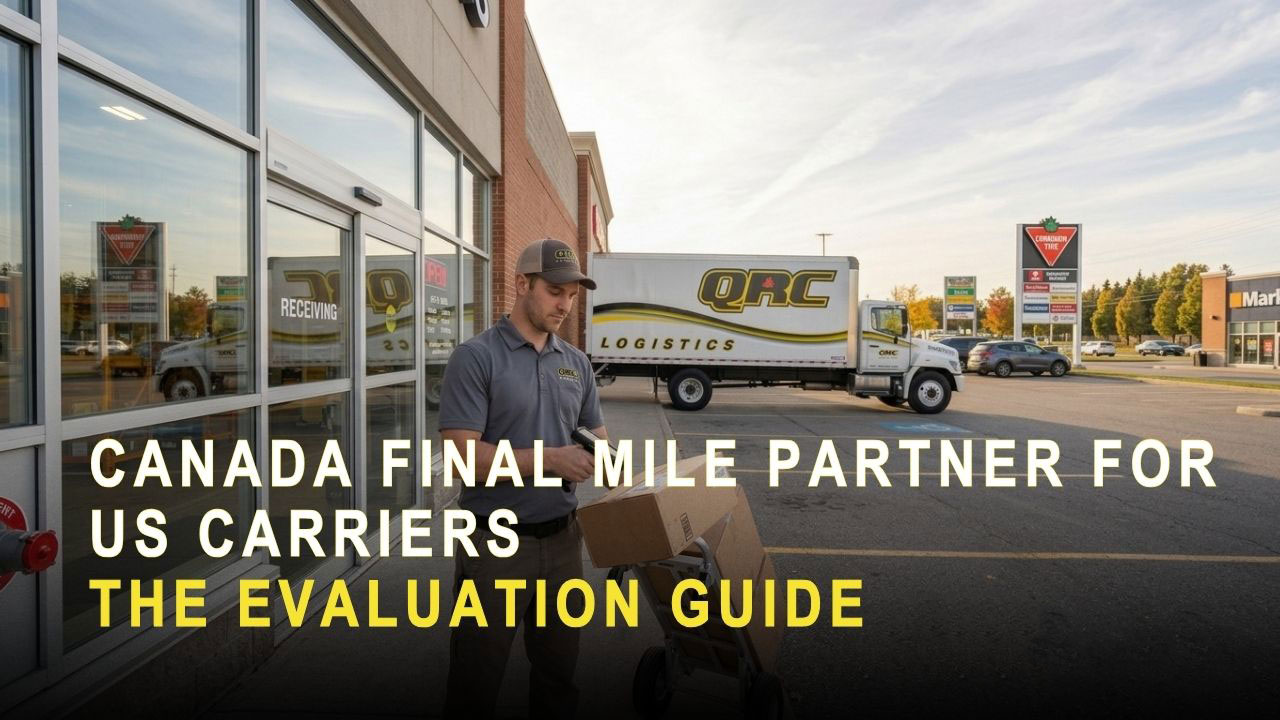
Before you score anyone, define the job. Not every 3PL handles every delivery type. And the ones who say they do? Some of them are quietly subcontracting half the work.
Start with these questions.
Can they handle appointment scheduling directly with receivers?
Some partners manage time-definite delivery windows in-house. Others push appointment scheduling back to you. If that coordination falls on your team, you are adding admin load you did not budget for. Ask how they manage it, not just whether they offer it.
Do they run white-glove service and inside delivery with their own crew?
There is a big difference between “we can arrange that” and “we run white-glove service in-house with liftgates, dollies, and blanket wrap.”
The first answer means a subcontractor you have never vetted is handling your shipper’s high-value freight.
The second means trained drivers with consistent standards. Look for a partner that has run white-glove operations for years, not months.
Can they deliver after-hours, on weekends, and on holidays?
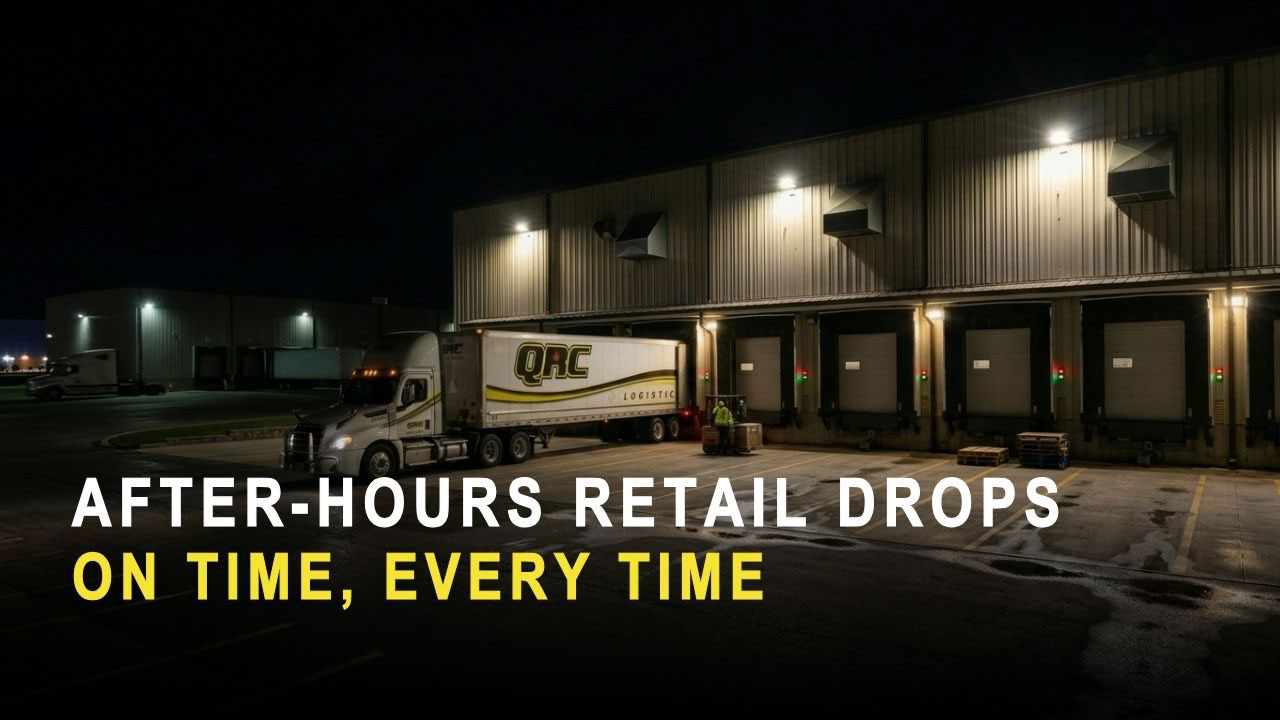
Some retail distribution chains need product placed before the store opens. That means after-hours retail drops at 5 AM on a Sunday or holiday deliveries with secure, unassisted dock access. If your 3PL partner treats this as an upcharge afterthought instead of a core capability, you will find out the hard way when the first off-hours delivery lands late.
Does one contract cover every shipment size with full fleet coverage?
- Courier parcels.
- Cartage and per-skid LTL on a 26-foot straight truck.
- Full truckload on 53 ft vans for GTA dispatch.
If you need three vendors for three delivery sizes, you are managing three sets of standards, three escalation paths, and three invoicing systems.
One 3PL covering every delivery type with full fleet coverage eliminates those coordination gaps.
How to score it: Rate each capability as “in-house,” “subcontracted,” or “not available.” Subcontracted is not automatically a deal-breaker. But it adds a layer of risk you need to price in.
2. Retail-Route Readiness: How Strong Is Their Dock Discipline?
If your cross-border freight touches retail, your Canadian 3PL partner’s retail compliance discipline directly affects your bottom line.
One missed time-definite delivery window. One wrong label. One pallet configuration that does not match the retailer’s receiving spec.
That is all it takes to trigger a chargeback that wipes out your margin on the load. Chargeback prevention starts at the dock, not in the back office.
Which retailers do they currently deliver to, and for how long? A partner running retail distribution routes for decades understands the specific receiving requirements for major Canadian chains. Each one has its own rules for booking, labeling, pallet builds, and unloading sequence. A partner who started retail compliance last year is still learning lessons at your expense.
Can they break out on-time performance for retail routes specifically? Not their blended on-time performance across all deliveries. Retail-route numbers are the ones that matter. If they cannot break it out, they are not tracking it at the level your freight demands.
Do they transmit compliant documentation the same day? Retailers that require specific paperwork will not wait for your partner to sort it out two days later. Compliant retail compliance documentation, transmitted the same day, is table stakes.
How to score it: Ask for their retail chargeback rate over the last 12 months. A partner who cannot produce that number either does not track it or does not want to share it. Both are red flags.
3. POD Standards and Scan Events: How Fast and Complete Is the Proof?
Proof of delivery is where trust gets built or destroyed. Your shipper does not care about your partner’s internal process. They care that the POD showed up fast, complete, and clean.
How quickly does the POD reach your system after delivery? Same-day electronic POD should be the baseline, not a premium feature. If a 3PL is still scanning and emailing paper PODs the next morning, that is a generation behind.
Does the POD include five-point scan visibility with photos, signature, timestamp, and piece count? Or just a signature? Look for scan events at each stage: scanned into the cross-dock, scanned onto the truck, scanned at delivery. Five-point scan visibility means you never lose sight of your freight between the border crossing and the receiver’s dock. Incomplete scan events create blind spots. Blind spots create disputes.
How do they document exceptions in real time? This is the one most U.S. carriers forget to ask about. When something goes wrong at delivery (short shipment, damage, refused freight), how does the partner document it? A strong final mile partner captures exception management details, photos, and receiver comments in real time on the same POD. A weak partner sends you a text message and hopes you sort it out later.
How to score it: Ask to see a sample POD from a recent delivery. What you see in the sample is what you will get on every load. If the scan events are thin, your documentation will be thin.
4. Cross-Dock and Damage Prevention: What Happens Between Border and Delivery?
Damage is not just a cost line. It is a relationship event.
How your Canadian 3PL handles cross-border freight from border crossing through cross-dock to last mile delivery tells you everything about how they will treat your freight long-term.
What happens to your freight between arrival and dispatch at the cross-dock? U.S. carriers drop trailers at the cross-dock facility, and the Canadian partner takes ownership from there. A well-run cross-dock operation sorts by region, stages for next-day regional service, and maintains organized storage throughout. Look for a facility that receives inbound freight 24/7 and stages for daily service across structured lanes.
How do they protect freight during staging and organized storage? While freight sits at the cross-dock between inbound reception and outbound transportation, how is it protected? Ask about organized storage protocols, inventory protection measures, and whether high-value product gets segregated. Detention costs add up when freight sits without clear staging discipline.
Do drivers follow a documented damage-prevention process? Do drivers use load bars, blanket wrap, or edge protectors as standard practice for cartage and LTL runs, or only on request? A good partner will tell you upfront if your freight is not packed for Canadian road conditions or multi-stop Ontario lanes. A bad partner will deliver it damaged and blame your packaging after the fact.
How fast is a claim initiated when damage occurs? Is there a dedicated claims contact, or does it go into a general inbox? Ask for their average claim resolution timeline. If they do not track it, that tells you something about where claims sit on their priority list.
How to score it: Ask how many damage claims they processed in the last quarter and what percentage were resolved within 30 days. Transparency here signals operational maturity.
5. Service Governance and Integration: How Do They Run the Partnership?
The real test of a Canada final mile partner is not how they perform on day one. It is what happens at month three when a pattern starts to slip and you need someone to fix it.
Service governance is the difference between a vendor and a partner.
It is also what keeps small service issues from turning into missed KPIs, frustrated shippers, extra internal follow-up, and preventable account risk.
Do they offer a documented service level agreement with measurable targets? Does the 3PL put on-time performance, POD turnaround, and damage rate targets in writing? Or is the commitment verbal? A verbal commitment is not a service level agreement. It is a hope.
Who do you call when something goes wrong? If the answer is a general dispatch line, you are one of hundreds of callers. Ask whether you get a dedicated account contact. Ask whether senior leadership is accessible when issues escalate. A 3PL whose president, VP, and GM get involved directly when things go sideways is fundamentally different from one that routes everything through a call center.
How are their Ontario lanes and national terminal coverage structured? Look for structured lanes with predictable schedules: daily GTA dispatch, next-day regional service to markets like Hamilton, Kitchener, and London, and twice-weekly runs to Northern Ontario. Strong lane planning means your cross-border logistics operation runs on a rhythm, not a scramble. Ask about service area coverage for outbound transportation beyond Ontario as well.
Are they EDI/API-ready from day one? Cross-border logistics cannot run on phone calls and spreadsheets. Ask whether the partner offers EDI/API-ready onboarding with structured data exchange. How quickly can their EDI and API systems connect to yours? What formats do they support? A partner that is EDI/API-ready from day one saves you weeks of integration headaches. If EDI and API integration is still “on the roadmap,” you are their beta tester.
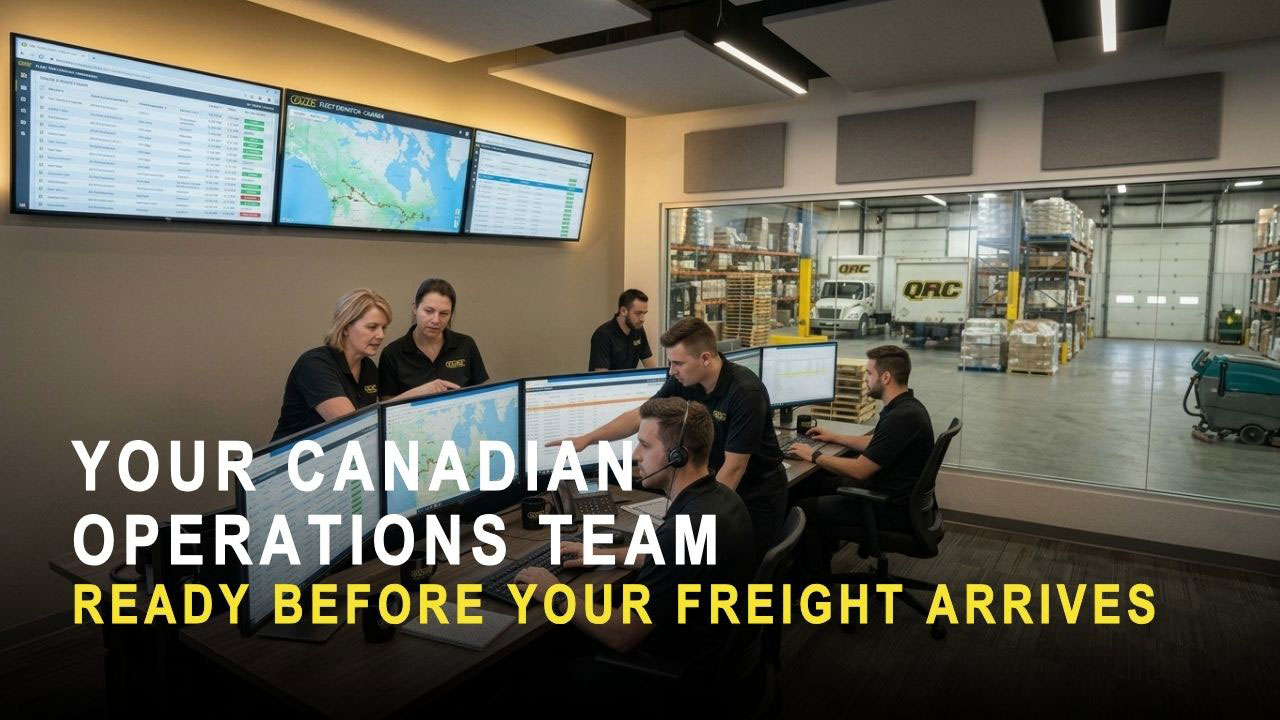
How often do they share performance data? Monthly scorecards should be the minimum. If the 3PL does not proactively report on their own on-time performance, you will always be the one chasing accountability.
How to score it: Ask to see a sample monthly scorecard from an existing client (redacted for confidentiality). If they cannot produce one, they do not run them.
6. Putting It All Together: How to Evaluate a Canada Final Mile Partner for US Carriers
You now have six categories to evaluate any Canadian final mile partner:
- Capability – white-glove service, appointment scheduling, after-hours retail drops, fleet coverage
- Retail readiness – retail compliance, on-time performance, chargeback prevention
- POD and scan events – five-point scan visibility, speed, exception management
- Cross-dock and damage prevention – cross-dock process, inventory protection, claims resolution
- Service governance – service level agreement, escalation access, reporting cadence
- Integration and lane planning – EDI/API-ready onboarding, structured lanes, national terminal coverage
Rate each category 1 to 5. Total the score. Use it to compare your top two or three finalists side by side.
No partner will score a perfect 30. That is not the point. The point is to see clearly which partner is strongest in the areas that matter most for your specific cross-border freight profile. A U.S. carrier running high-value electronics into Canadian retail distribution has different priorities than one moving industrial supplies to commercial docks.
Beyond the scorecard, consider the full scope of services your 3PL partner can offer.
- Warehousing
- E-commerce fulfillment
- Pick and pack
- Hold-and-release coordination
- Outbound transportation
All factor into whether a single partner can grow with your cross-border logistics needs. If customs clearance coordination is part of your cross-border freight workflow, ask whether the 3PL can support that process or connect you with a trusted broker at the border crossing.
The scorecard forces the right conversation. And the right conversation protects your margins and your shipper relationships before the first load crosses the border.
It also helps you choose a partner that reduces avoidable chargebacks, improves delivery visibility, shortens issue resolution time, and takes operational pressure off your team.
When This Level of Evaluation Matters Most
Not every U.S. carrier needs the same kind of Canada final mile partner.
If your freight profile is mostly low-touch, non-retail freight where the only buying criteria are the cheapest linehaul rate and basic delivery coverage, you may decide you do not need the level of operational control, scan visibility, retail discipline, and escalation access outlined above.
But if your business depends on protecting shipper relationships, reducing chargebacks, maintaining delivery visibility, and keeping cross-border freight predictable once it hits Canada, those details matter more than the cheapest quote.
Why QRC Logistics Is the 3PL Partner You Are Looking For
You have the scorecard. Now here is what it looks like when a Canada final mile partner checks every box.
QRC Logistics has been operating since 1978. That is not a marketing line. It is four decades of cross-border freight, retail distribution, and final mile delivery across Canada.
Cross-dock and location. QRC’s 300,000 sq ft cross-dock facility in Halton Hills sits minutes from Pearson Airport, with 24/7 inbound reception. U.S. carriers drop trailers and head south. QRC takes ownership, sorts by region, and stages for next-day regional service across structured Ontario lanes.
Fleet coverage. Courier division. 26-foot straight trucks with tailgate for cartage and per-skid LTL. 53 ft dry vans for Greater Toronto Area dispatch and full truckload. One contract. Full fleet coverage. No juggling three vendors.
Structured lanes and time-definite delivery windows. Daily GTA dispatch from Halton Hills. Next-day regional service to Hamilton, Kitchener, London, and Ottawa. Twice-weekly Northern Ontario runs reaching Sudbury and Sault Ste. Marie. Every delivery hits a time-definite window, not an estimate. From Pearson Airport proximity to Northern Ontario coverage, the structured lanes are built for predictable cross-border freight flow.
White-glove service and retail compliance. QRC has run white-glove final mile delivery and retail distribution routes since the 1990s. Five-point scan visibility tracks every scan event from cross-dock intake to final delivery. Retail compliance and chargeback prevention are built into the dock process, not bolted on after the fact.
Appointment scheduling and after-hours retail drops. Managed in-house. Weekend, night, and holiday deliveries are standard capability, not an afterthought. Product in place before the store opens.
EDI/API-ready onboarding. QRC’s partner program includes EDI/API-ready onboarding with structured data exchange from day one. No waiting for integration. No spreadsheet workarounds.
Direct leadership access. When things escalate, you talk to the president, VP, or GM directly. Not a call center. Not a ticket queue. QRC Logistics operates as an extension of your business, with a service level agreement backed by monthly performance reporting and structured escalation.
Beyond the final mile. Warehousing and distribution, ecommerce fulfillment, hold-and-release for national product launches, and outbound transportation across Canada. QRC’s warehousing capabilities mean your freight can be stored, staged, and dispatched from one facility. One 3PL partner that grows with your cross-border logistics operation.
Your Next Step
Canada should be a growth lane, not a liability.
The right final mile partner makes cross-border freight predictable, your shippers confident, and your margins protected. The wrong one costs you sleep, chargebacks, and eventually the lane itself.
If you want to see how QRC Logistics scores against this checklist, request the Partner Kit.
No pitch deck. Just a direct conversation about your freight, your Ontario lanes, and whether QRC is the right fit.
We will come prepared. You should too.